Read About Indian Chai Stories

Our Writers - in Pictures!

Showing posts with label Mirza Yawar Baig. Show all posts

Monday, March 30, 2020

Mango Range but no mangoes

by Mirza Yawar Baig

In 1989, I was promoted and transferred from the Anamallais to Assam. I was in two minds about this as the idea of being next door (so to speak) to Kaziranga and Manas National Parks with their rhinos was very attractive. However, after reflection and some very good advice, I declined the posting. I figured that if I went off to Assam, which was about as far as you could get from our corporate office in Chennai, I would be forgotten, and this would have a negative impact on my career. In the corporate world it is important to be physically visible, not only visible through reports. Paradoxically if you are doing well and all your reports have nothing to make anyone concerned, you are not rewarded but forgotten. It is indeed the squeaky wheel that gets the grease, and this is nowhere truer than the corporate world.

This was a trying period because suddenly I had no specific job. I couldn’t complain as it was my own doing. I had to leave my job as the Manager on Lower Sheikalmudi Estate because that job had already been assigned to another colleague. That left me literally homeless as there were no bungalows in the Anamallais where I could live. I was sent off to the Mango Range until the management could decide what to do with me. I was assigned a bungalow on Caroline Estate, located in a forest thicket, which was in a dilapidated condition. The location of the bungalow was lovely, and it was a joy to wake up to bird calls every morning. However, the house itself looked like it would collapse on our heads at any time. Of particular concern were the walls, which were so waterlogged that they had fungus growing on them in huge patches. My wife is an amazing homemaker and all her talents were put to test in this place. Out of this dilapidated house she created a lovely home which we enjoyed living in.

Since I had no regular job, I decided on doing two things: For a long time, I had been talking about the need for systematic training of new managers. The system in the plantations at that time was that a new assistant would be put under a manager and what he learnt or didn’t depended on the capability, interest, and energy of his manager and field or factory officers. If the assistant was lucky and got some people who were both knowledgeable and interested in teaching, then he learnt a great deal. If not, he remained guessing. This is a highly undesirable system, which is very time and energy intensive and does not give standard results. I had been saying for several years that there was a need for a standard textbook on tea plantation management, which could be used to provide standardized training. Any additional inputs that the young man’s manager and staff could give him would only add to this, but he would not be deficient in the basics.

During my stay in Mango Range, I decided to write this book and in 6 months, I produced a 200-page Manual of Tea Plantation Management. At the time of its publication there was no such book on the market, and it was a source of great satisfaction for me. My company published it as an internal training book and though it was never a commercial publication, it did get fairly wide publicity and was used by many new managers. It has since gone out of print and to the best of my knowledge, it has not been reprinted. A big lesson for me was the power of the written word and its high credibility in making your customer base aware of what you have to offer. After that book there was no way that I could be ignored, not that I feared that. I had a lot of people who I had dealt with over the years rooting for me in the company.

The second thing I did was to spend a lot of time in Mango Range factory and hone my expertise in CTC manufacture of tea. I was very fortunate in that Mr. T.V. Verghese, who had retired as a General Manager in Tata Tea and was consulting with our company on manufacture, was a regular visitor and we became good friends. He shared his knowledge freely and I learnt a great deal. He was a practical teacher, which meant that I got to spend a lot of time on my back on the floor meshing CTC rollers with grease anywhere on my face and body that grease would stick. I learnt all aspects of manufacture hands-on further reinforcing my belief that learning comes from doing – not from talking about doing. In Murugalli Estate, I’d had a lot of experience in Orthodox manufacture, and even though I was the Assistant Manager in charge of the Mayura Factory project, the premier CTC factory in South India, I was moved to Paralai Estate as soon as the construction was over.

Consequently, my knowledge of CTC manufacture was weak. In Mango Range, as a student of Mr. T. V. Verghese and thanks to his willingness to teach, I rectified that deficiency. It was ironic that thereafter I went to Ambadi, which was a rubber plantation and never really used this knowledge, but it did come in use for writing a paper comparing Orthodox and CTC methods, which I presented at the UPASI Annual Conference in 1989, thanks to encouragement of Mr. Rawlley. Nikoo was to do this presentation and I had written the paper for him. On the day of the presentation, Nikoo said to me, “My throat is bad, and I think I have lost my voice, so please present the paper.” When you have friends like this, you don’t need enemies. I am being humorous, but he presented me with a challenge and an opportunity. The challenge was that he sprang it on me, but I guess his logic was that since I wrote the paper, how much prior notice did I need? The opportunity was that I could be noticed positively which could only do me good. Nikoo was a dear friend and mentor and we remained in touch until he passed away.

His name was Frank Augustine (I used to call him Frankenstein) and he looked like a dried prawn. But when he swung the club, he always hit the ball with that sweet phut that all golfers love to hear. 

Mango Range was an interlude in my career. I was marking time and waiting for some positive change to happen, and in the meanwhile I enjoyed myself. It has long been my philosophy to live one day at a time and to try to create as much happiness for myself and around me as possible. I have learnt that the two are the same. You can only be happy if those around you are happy. This is true whether you are an individual, an organization, or a country. Imagine what a wonderful world we would have if instead of competing, we collaborated and shared resources. We would all be wealthier, happier, and healthier. I have always held that the secret of happiness is to be thankful for and enjoy the small things in life. There are far many more of them than the big events. If we can enjoy the small things, then we can be happy all the time. The key to enjoyment is to appreciate them and be thankful for them. The key to contentment is not amassing, material but in being thankful for what one has. The happiest people are those who are content. Content people are those who are thankful. Material wealth has nothing to do with it.

One of the things that I was very appreciative of and thankful for was the leisure that I had in Mango Range. I had no specific work except what I decided to do for myself. And I was still getting my salary. I decided to learn to play golf. I got a caddy from Ooty Gymkhana Club (Ooty Gym) to come and stay with me in the estate for three weeks.

His name was Frank Augustine (I used to call him Frankenstein) and he looked like a dried prawn. But when he swung the club, he always hit the ball with that sweet phut that all golfers love to hear. And the ball would travel straight like a bullet down the freeway. Shows that it’s technique and not strength of the arm that works in golf. Also, in many other things in life. My club, on the other hand, would come up with a good measure of earth and top the ball to boot. Frankenstein believed in hard work – meaning, making me work hard. He set up a practice net, produced a set of a hundred used golf balls and we were good to go. I would hit the ball into the net until I felt my arms would drop off. All the while, Frankenstein would sit on his haunches under the Champa tree that was to one side and watch me and make clucking noises.

The effect of all this clucking and my swinging at the ball became clear when one day about midway in our training Frankenstein suggested that we should go and play a round at the club. So off we went on the three-hour drive to Ooty. After a cup of tea and a sandwich, I teed off and that is where all the practice paid off. Ooty Gym has very narrow freeways bordered by spiky gorse. If you didn’t hit your ball straight, you would send it into the gorse and then you may as well forget about it because if you want your ball back, you must pay by leaving your blood and skin on the gorse and acquiring gorse thorn furrows in your hide. As Frankenstein continued his mother-hen act, I could see the distinct improvement in my style and capability.

Another one of my joys while living in Mango Range was the time I got to spend with Mr. Siasp Kothawala and his wife Zarine, at their lovely guesthouse in Masanigudi called Bamboo Banks. Masanigudi is in the foothills of the Nilgiris at the edge of the Mudumalai-Bandipur National Park, so there is a lot of wildlife around. You see a lot of Chital, some Gaur, and some elephant, the latter being dangerous as they are too close to human habitation and often in conflict with people.

I saw a Peregrine falcon hovering in the sky ahead of me. I pulled up to watch it and saw a dove break out of cover from a hedge and head for the safety of the forest flying very fast. The falcon folded his wings and stooped coming down like an arrow out of the heavens. 

Mudumalai is also supposed to be a tiger reserve though I have never seen a tiger in it. The gate of Bamboo Banks was an ingenious contraption. It was a pole, suspended horizontally across the road and had a plastic water container on one end. There was a sign for you to tug on a rope if you wanted to open the gate. The rope was connected to an overhead tank so when you tugged it, water would flow into the plastic can on the pivoted side of the pole, which then went down and lifted the other end. All this happened while you were comfortably sitting in your car. The water would then drain out of a hole in the can and flow into an irrigation ditch and into some fruit trees, closing the gate. Siasp was a tea planter and had worked for the Bombay Burma Tea Company (BBTC). He then went into the tourism business and did very well. We would spend lovely afternoons talking about the tea industry and the general state of the world and drinking tea. Siasp always had an angle to everything, which he would put across in a hilarious and entertaining way.

Siasp also had horses on his farm and having had tea I would take one of the horses and go riding in the buffer zone of Mudumalai National Park. This had its exciting moments and I recall two of the best. One day, late in the afternoon, I was riding out of the farm and into the dry fields that surrounded it before the track entered the bamboo thickets that bordered Mudumalai, when I saw a Peregrine falcon hovering in the sky ahead of me. I pulled up to watch it and saw a dove break out of cover from a hedge and head for the safety of the forest flying very fast. The falcon folded his wings and stooped coming down like an arrow out of the heavens. The dove had almost made it to the forest cover when the falcon hit it in middle of its back with a slap that I could hear where I was sitting on my horse. The dove must have died with the impact, but the falcon bore it to the ground and then holding it in its claws, looked up right and left, its pale yellow eyes scanning the world to challenge any takers. What a magnificent sight that was. The image is engraved in my memory.

As I rode on, I took a path that went along the middle of a forest glade which had scattered clumps of bamboo. After a kilometer or two, the path passed between two very thick and large clumps of bamboo and dipped into a dry stream bed and went up the other bank. I used to like to gallop this stretch and my horse knew the routine. Strangely, on that day as we came near the bamboo clumps my horse shied and stopped and refused to go forward. This was odd behavior, but I have enough experience to know that in the forest your animal is your eyes and ears and you only ignore its signals at your own peril. I listened to the horse and turned around and then took a long and circuitous route to go around whatever it was that was bothering my horse. As we came around, I saw what was bothering him. It was a lone male elephant which was hiding behind the clump of bamboo. Now I have no idea what the elephant’s intention was, but I was not taking any chances. My horse obviously didn’t like the idea of passing close to the elephant and if we had continued on that track, we would have encountered that elephant where the path was the narrowest and where it was bordered and hedged in by the bamboo. In case of an attack, we would not have had any chance to escape. Lone elephants are famous for such attacks. A rather terminal situation which we were happy to have avoided.

On one of those trips to Bamboo Banks, I saw an elephant by the roadside, a little way inside the forest. As this was quite close to the Forest Department’s housing and elephant camp, I thought that it was a tame elephant and decided to take a picture. I had a small box camera at the time in which you were the telephoto – if you wanted greater magnification, you had to go closer to the object. So, I got out of the car and walked almost to the side of the elephant and took a photo. Suddenly I heard someone yelling at me, his voice high pitched in panic. I looked up and there was a forest guard, a good two-hundred meters away, waving frantically at me and yelling at me to get back into the car. Since it is not an offence to get out of your car on the main road in Mudumalai, I was irritated at this man’s insistence but since I already had my picture, I returned to the car. As we drove on and came up to him, the man waved us to a stop and still in an angry voice asked me in Tamil, ‘What do you think you are doing? If you want to die, go do it somewhere else.’
See also https://yawarbaig.com/seewithyourheart/mango-range-but-no-mangoes/
I said to him, ‘Hey man! Relax. What is all this about dying? I was only taking a picture of one of your elephants. Who said I want to die?’ The man said, ‘Our elephants? That was a lone wild tusker that you were standing next to. I have no idea why he let you get that close or why he did nothing. Your lucky day. That is a wild elephant and a lone one at that. Don’t do these stupid things.’ And he went on for a while in the same vein. I was so shocked that I listened in silence. And of course, how can you get angry with someone who is only interested in preserving your life? But I still have the picture, which is very impressive.

Final story here involving my good friend Siasp. Siasp had a very good friend in Mysore who was the Commandant of Police in charge of the Karnataka Armed Reserve Police Mounted Company, called SG Mariba Shetty. https://www.thehindu.com/features/metroplus/society/thoroughbred-tales/article4054508.eceMariba Shetty was known for his high standards and a visit to the stables of the Armed Reserve Police Mounted Company was a delight to say the least. I love the smell of freshly groomed horses and fresh hay. Yes there is the smell of horse dung also but it is a pleasant smell. I spent a lot of my youth grooming horses, because that is how we were taught riding at the AP Riding Club in Hyderabad, by our ex-cavalry Ustaads, Abdul Hameed Khan and Sayeed Khan. Our training was rigorous. You started one hour before it was time to ride by mucking out the stable and grooming your horse. Then you saddled up and you were ready to go. All this was unwritten. Nobody forced you. If you didn’t want to do that and wanted to ride a horse like you ride a motorcycle by just getting on and getting off and handing it to a syce, you could do that. But then you were given the worst nag in the stable. If you wanted to ride the Thoroughbreds or the Kathiawari and Marwari horses, then the unwritten rule was that you showed your readiness by starting with mucking out the stables. Great character building, if you ask me.

To return to Siasp’s story with Mariba Shetty, let me tell you how Siasp told me. “You remember Mariba Shetty? The Mysore Mounted Police Commandant?”

“Yes, I do. What happened to him?”

“I heard that there was a riot during a Dussera procession, and he tried to stop it but was pulled off his horse and killed. I was very sad to hear this. You know he was a great friend of mine. So, I wrote a long letter to his wife, telling her what a wonderful man he was and how much I appreciated our friendship.”

A couple of weeks passed. Then I get a call from Mariba Shetty. He says to me, “Mr. Khotawala, I called to tell you that I am well and that report about my death was wrong. Thank you very much for your letter. I didn’t know you thought so highly of me.” Big lesson in telling people that we appreciate them while they are alive, instead of writing moving obituaries after they are dead. In this case, the man got to read his obituary but in most cases, it is a waste of effort.


Meet the writer: 


'Mirza Yawar Baig. President, Yawar Baig & Associates (www.yawarbaig.com). Business consultant specializing in Leadership Development and Family Business Consulting. Was a planter from 1983-93 in Anamallais and Kanyakumari. Author, mentor, photographer, speaker, inveterate traveler. Working across boundaries of race, religion and nationality to bring hearts together. I was in tea for seven years and in rubber for three. Also planted coffee, cardamom, vanilla and coconut.' 

You can read all Mirza Yawar Baig's stories on this blog here: https://teastorytellers.blogspot.com/search/label/Mirza%20Yawar%20Baig 
It's My Life,  Yawar's book, here: http://amzn.to/28JpEC2

Is this your first visit here? Welcome to Indian Chai Stories!
Do you have a chai story of your own to share?  

Send it to me here, please : indianchaistories@gmail.com. 

My name is Gowri Mohanakrishnan and I'm a tea planter's wife. I started this blog because one of the things that I wouldn't want us to lose in a fast changing world is the tea story - a story always told with great seriousness, no matter how funny - always true (always), maybe a tall tale, long, or short, impossible, scary, funny or exciting but never dull.
 Happy reading! Cheers to the spirit of Indian Tea!

Friday, August 9, 2019

Butler English and more

by Mirza Yawar Baig
You all know my butler Bastian whom I have written about earlier.
Bastian, like most of his tribe, spoke ‘Butler English’ and was very snobbish.

Bastian had a habit of translating Tamil names into English and announcing anyone who came with his translation of the person’s name. He didn’t do that with the Doraimaar (Manager class) but did it with anyone else. Workers or union leaders didn’t come to the bungalow to meet the Manager. We met all workers, supervisors, staff and union leaders only at the morning muster or in the Estate Office.

This was a universal rule in all estates which was strictly adhered to. This has nothing to do with being snobbish or class conscious but with maintaining boundaries of work and personal time and space. We lived on the job, as it were, and if we didn’t do this, we wouldn’t have had a single day’s peace. Having said that, there were some special people who had special privileges. In my case these were my tracker, who told me about the movement of wildlife in the forests adjoining our estates in the Anamallais, the supervisor who built the hides in trees or rocks for me to watch wildlife, and the two Ramans who accompanied me on my hikes on Grass Hills. All of them came to the bungalow if they needed to meet me.

The norm was that they would first go to the back, to the kitchen and Bastian’s pantry and he would give them a cup of tea and they would chat. Then he would see what I was doing and if I was free, he would announce that so-and-so had come to see me. But the way he did it was, to say the least, very funny. He would say, “Master, Seven Hills is here to meet Master.” Seven Hills being the literal translation of Yedumalai. Or he would say, “Master, Golden Mountain is here and wants to meet Master.” Golden Mountain being, yes you guessed it, Thangamalai.

When I was in Paralai Estate, my bungalow was just off the main Valparai road, opposite the Iyerpadi Estate Hospital, the domain of Dr. John Phillip and his charming wife, Dr. Maya. John and Maya were very good friends. John was one of the finest diagnosticians that I have ever had the pleasure of knowing, who could tell you what was wrong with your soul by looking at your toenails. Maya, in addition to being a physician, was a very creative artist and painted and made all kinds of beautiful things.

One day, I had almost finished my morning rounds and had a nasty headache. So, on the way home for lunch, I dropped in at the hospital to meet Dr. John and get something for my headache.
As I drove into the hospital compound, I saw a lot of urgent activity with nurses and attenders running here and there. I asked Mr. Karunakaran, the Pharmacist, who held fort when Dr. John was away, what was going on. He said that there was a woman in labor who was terribly anemic and needed a blood transfusion. They were trying to find her family to donate blood.

I said to him, “Take mine. I am O + and a universal donor.” Karunakaran looked surprised. A nurse standing by him, looked shocked. “You will donate blood for a worker woman?” she asked. “We are trying to find her people (Dalits) to donate blood.” I said to her, “Look, I have no time for this. Take my blood and give it to her. You don’t want her dying with her baby while you hunt for her relatives.” While all this was going on, Dr. John came on the scene and on being informed that I was offering to donate blood and the reluctance of the staff to accept it, he said, “He wants to donate his blood. What is your problem? Just take it.”

I was duly laid down and bled to the extent of two bottles of blood. It was thick and almost black with hemoglobin and had my friend John smiling in satisfaction. They disappeared with the blood into the operation theatre. I was kept under observation for a while and given some tea, just to ensure that I didn’t croak. I realized that in all this, my headache had disappeared. Clearly donating blood cures headaches. I then went home and had lunch and went off for my siesta - a most civilized practice that I learned to do in the plantations and have adhered to ever since. I am told it is also very good for the heart. It is certainly very good to rejuvenate you for the rest of the day.

After my siesta of about forty-five minutes, I got up for my cup of tea, when Bastian announced, “Master, Golden Mountain and the entire Works Committee are here to meet Master.” I was surprised because it was my rule that I never met any union leaders at home, and everyone knew and respected it. What was so urgent today that they couldn’t meet me in the office?

The land you are born in is not your motherland. It is the land you die in and are buried in that belongs to you.

I walked out on to the veranda to see Thangamalai, who was the head of the union, Madasamy who was his Deputy and entire Works Committee with them. I was a little apprehensive also, because usually it is not good news when the whole committee wants to meet you urgently. We made our greetings. Then I asked them why they had come. They didn’t say a word. Thangamalai stepped forward and bent down to touch my feet. I stepped back in amazement and irritation because I never encouraged the touching of my feet. They knew this.

I told them, “Why are you touching my feet? You know I don’t like this and don’t allow anyone to do it.” Thangamalai said in a grave tone, “Yes Dorai, we know. But today you will have to allow us to touch your feet. So, please don’t stop us.” He then bent down and touched my feet. And all the others followed suit. I stood there, totally amazed at all this. When they had all finished, I asked them, “So, tell me, what is all this for? What did I do?”

Thangamalai said, “Dorai, today you did something that has never happened in the more than one hundred years since this tea was planted. You gave your blood for one of us. No manager ever did this. So, we must thank you.”

I said, “What is so special about that? Wouldn’t you have done the same for me?”

“Yes Dorai, we would. But Doraimaar (Manager class) don’t do it for us. You are the first one and the only one who ever did it.” Then he said something which has stayed with me ever since. He said, “Dorai, this is our land. It is our land not because we were born here but because we will be buried here, if we die. It can never be the land of the Managers, because if you die, they will take you away to your hometown to bury you. They will not bury you here. The land you are born in is not your motherland. It is the land you die in and are buried in that belongs to you. But from today, this is also your land because your blood is now our blood.”

I had tears in my eyes and to this day when I think of this whole event, it fills my heart with warmth and love for these simple, lovely people. I have never believed in caste and class divisions and never practiced them and that day, they accepted me as their own. I was a Dalit for them and for me that was the greatest honor. 
Lower Sheikalmudi Manager’s bungalow where we used to live ( Pix by author)
 There is a very happy ending to this story. Almost twenty-five years later, in 2010, I returned to the Anamallais with my wife Samina and some friends of ours from South Africa and my nephew Aly, to show them one of the most beautiful places on earth. We stayed for two nights in the bungalow we used to live in, the Manager’s bungalow on Lower Sheikalmudi Estate. We walked the trails that I used to walk and met all those workers and staff who were still there. Many had retired. Some had passed away. But those who were there, remembered me and left their work and came to meet me. I was taken in an informal procession and ‘installed’ in my old Muster. Someone put a shawl on the chair for me to sit upon. Others brought tea and vadas from the teashop which every estate has. Many of my old workers brought their children to meet me and told them, “This is the Dorai we have told you about.”

One young fellow came up to me, greeted me with, “Vanakkam Dorai.” I returned his greeting. He asked me, “Do you recognize me?” I always find this question very disconcerting. If you don’t remember them, it puts you in an embarrassing position. You can try to wing it by saying, “Of course I remember you. How can I ever forget you?” But some horrible fellows won’t let you get away with that. They will persist, “Then tell me who I am!” Then you must say, “You are the one for whom I pray every day that your socks should shrink in the wash and that you should discover after having showered that you forgot your towel in another room and that when you are in a rush to urgently go to the toilet in the airport, after you have done the deed, you should discover that you were in the toilet meant for the opposite gender.”
 
 Manjaparai view – Sholayar Dam in the distance (Pix by author)
No, I didn’t say all that. I said to him, “I am sorry I don’t recognize you.” He said, “Not surprising Dorai. The last time you saw me was twenty-five years ago. I am the little boy who you would always give a ride to school on your bike. I would be walking down the road to the school and you would come down from the office and you would always stop and ask me to hop on behind you and you would take me to school. I can never forget you.” Then I remembered him of course. For me it was such an unremarkable thing to do. I like children and this little fellow was so happy to ride behind me and it made him such a big shot before all his friends that I always gave him a ride. Of such simple, unthinking, spontaneous actions are enduring memories made.

The day after we arrived, word got around to the workers of Paralai that Baig Dorai had come after twenty-five years and many people came to meet me. In the course of that, came two women and a man. The man was an old servant of ours who had worked as Bastian’s assistant, Asaithambi. He greeted me, “Vanakkam Dorai.” Then he gestured to the two women to come forward and asked me, “Do you know who they are Dorai?” I had no clue. He said, “This one is the one you gave your blood to. And this is her daughter. Without that blood they would both have died that day. It is with your blood in their veins that they are living. And Dorai, this girl is studying medicine in Coimbatore.”

I wept with joy and gratitude. That is all that I could do.

Is this your first visit here? Welcome to Indian Chai Stories!
Do you have a chai story of your own to share?  

Send it to me here, please : indianchaistories@gmail.com. 

My name is Gowri Mohanakrishnan and I'm a tea planter's wife. I started this blog because one of the things that I wouldn't want us to lose in a fast changing world is the tea story - a story always told with great seriousness, no matter how funny - always true (always), maybe a tall tale, long, or short, impossible, scary, funny or exciting but never dull.
 Happy reading! Cheers to the spirit of Indian Tea!


Meet the writer: 


Mirza Yawar Baig. President, Yawar Baig & Associates (www.yawarbaig.com). Business consultant specializing in Leadership Development and Family Business Consulting. Was a planter from 1983-93 in Anamallais and Kanyakumari. Author, mentor, photographer, speaker, inveterate traveler. Working across boundaries of race, religion and nationality to bring hearts together. I was in tea for seven years and in rubber for three. Also planted coffee, cardamom, vanilla and coconut. 
You can read all Mirza Yawar Baig's stories on this blog here: https://teastorytellers.blogspot.com/search/label/Mirza%20Yawar%20Baig 
It's My Life,  Yawar's book, here: http://amzn.to/28JpEC2

Thursday, June 13, 2019

Of Butlers and other superior life forms


by Mirza Yawar Baig
Mirza Yawar Baig writes a touching tribute to Bastian the Butler, a gem of a man from a bygone era; his 'friend and a very good guide for me to ease into plantation life'.


Our servants in the plantations were wonderful people. Many were old hand downs from the British planters who had trained them in their ways. Some had special attitudes inherited from the British, who they imitated faithfully. The pecking order of servants was very strict. At the top was the Butler. He was cook, waiter, and until you got married, the valet; all rolled into one. He would cook your meal – usually to his own satisfaction. He would serve you at table; supervise those who took care of your clothes, house, car, and garden. He would more often than not iron your clothes himself and would cook some of the special things, especially the puddings. He would ensure that there was always soap in the dish and that the towels in the bathroom were always freshly laundered.

The Butler was followed by the Chokra (a Hindustani word with a derogatory tone which literally means ‘urchin’). This worthy was the assistant of the Butler who did all the cleaning, scrubbing, and polishing work in the bungalow. Then there was the gardener who did all the work outside. If you had a cow, there was the cow-keeper. There was the dhobi (washer man) who washed and ironed your clothes. All these for you as the Assistant Manager. The Butler made sure that there were always flowers arranged in every room. Some Butlers were excellent artists at arranging flowers, having learned these and other skills including cooking European meals from the wives of British planters. Most useful for us of course.

Bastian at his best – service from the right side
This experience also gave them a sense of standards that is almost impossible to find today. For example, my Butler Bastian would always be dressed in clean white shirt and dark trousers with a belt. He would always be clean shaven, would always have used something to hide the smell of the cigarettes he used to smoke, which I would never have imagined if I hadn’t actually seen him once without his knowledge. As a courtesy, I never walked into his pantry without making some noise on the rare occasion that I did go. It was always more polite and convenient to ring the bell, conveniently located in every room in the house. He would not wear shoes inside the house no matter how much I tried to force him to do, especially in the cold winters.

When we had guests and he could not serve from the correct side, he would say, “Sorry, wrong side Sir.” Nothing was taken for granted, including the fact that most of those who heard this statement had no idea what he meant. They hid their confusion by laughing. He would always greet me at the door when I came home, push my chair in when I sat at table, and then serve me with a towel on his arm. And at the end of the day when I had eaten dinner and he knew I was not going to need anything else, he would come and say, “Good night, Master.” This would be followed by the other servants in strict order of precedence.

When you decided to have a party and invite some people, a very essential part of plantation life, your Butler would advise you about who you should invite and even more importantly, who you should not invite; either because of the wrong image that would give you or because that person did not get along with the other more important guests. He would advise you about what each one liked to drink and what anyone was allergic to.

Bastian was horrified when I told him that we would not serve any alcohol. For a long time, he was convinced that he was working for the wrong person because the Butler’s prestige would go up if I was promoted quickly and we moved into the Manager’s bungalow. He held the popular opinion that without serving Scotch whisky at parties to the bosses, I would get nowhere. I suppose he also did not like the thought that he would not be getting his quota free of cost either. I, on the other hand, was of the opinion that promotion must come as a result of performance, not on account of the amount or cost of whisky served. Mercifully, my career progression bore me out and proved him wrong. What - if anything - he did about his quota I never discovered and neither did he ever appear to be under the influence, as it were. So that part of Bastian’s life remains a secret.

When you got promoted and went to the Big Bungalow, you got an additional servant inside the bungalow and a driver for your car. The pecking order, which remained the same, was very strictly followed. Almost always the only person you spoke to or who spoke to you was the Butler. He was the one who handled the money. You would give it to him, to give to the others or to the provision merchant from whom food for the bungalow was bought on credit. Credit played a major role in life as most assistants had no money.

People spoke with great respect about managers who were seen as incorruptible and with disgust and disdain about managers who were corrupt.

Many who liked high living had club bar bills that took up most of their salaries and so they lived on credit. This was obviously an evil because apart from the obvious reasons, many Butlers set up their own kickback systems as a result. It was a given that you would pay more for provisions than other people but that was the burden of being the Chinna Dorai (Small Boss). Many British managers were very stingy and corrupt and set up systems of gratuity and underhand payment in kind that they would write off to some estate expense or the other. These systems were well learnt by their Indian subordinates who added to these systems of subterfuge and deception and ran a very corrupt ‘ship’ as it were.

One cardinal fact of plantation life always took its toll – nothing in planting life was private. If you took a bribe, its exact amount, who gave it, and for what, was the subject of much conversation in the bazaar. If you refused to be corrupt and lived a life of honesty, that also became common knowledge. The result was that the actual love and respect that you received from the workers and staff was directly proportional to the kind of life you lived. And in the end, it affected your own success, the loyalty that people showed you, and the peace of mind you lived with. People spoke with great respect about managers who were seen as incorruptible and with disgust and disdain about managers who were corrupt. And in a place where you were the subject of most conversation, public opinion made a very big difference.

I had two Butlers during my stay in the Plantations. Bastian was with me when I joined in Sheikalmudi as Assistant Manager and remained with me for two years. Then he left and Mahmood (more about him later) joined my service. Mahmood was with me when I got married and stayed with me for a total of about three years. When I returned to Lower Sheikalmudi as the Manager, Mahmood left and settled down in Ooty, his hometown. Bastian then returned to my service and remained with me until I moved to Ambadi Estate in Kanyakumari. He then left and settled in Kotagiri.
Lower Sheikalmudi Manager’s Bungalow where we lived with Bastian in charge

A few months later we learnt through the grapevine that Bastian had passed away. I was very sad indeed to hear about his passing. Bastian had been a friend and a very good guide for me to ease into plantation life. A few months later I was in Kotagiri visiting my dear friend Berty, when driving down the road, who do I see walking up the hill, but Bastian. I was so delighted that I yelled out his name and swerved the car to park it, almost making the rumor about Bastian’s ending true in the process. Passersby must have thought it very strange indeed to see this Peria Dorai (Big Boss) jump out of his car and hug an old Butler. But that was my Bastian. A man who served faithfully and who was a friend more than a servant. He was completely loyal to me, preserved confidentiality in all matters, and treated me with utmost respect.

Bastian was a brilliant cook and claimed that he knew more than 100 recipes for soufflés and puddings. I have no doubt he did, and I was the beneficiary of many, if not all. His cream soups were brilliant. So were his fruit soufflés. He would top some of them off with caramelized sugar like an elaborate web. Very stylish. But for the love of anything, he wouldn’t teach anyone else how to cook those things. My wife and many other ladies tried every trick to learn. Bastian would very politely say, ‘Of course Madam. I will teach Madam. Madam come when I am making it.’ But when Madam went there, at the final moment, he would do something to distract attention and there it was all ready and made and Madam would have to wait for the next opportunity.

After a few such attempts, Madam got the hint and satisfied herself with eating Bastian’s cooking without trying to learn how to cook it. On one occasion, my wife suggested to Bastian that he should teach the houseboy who was his assistant in the kitchen. Bastian’s response was classic. He said, ‘No Madam. Chokra dull Madam. Can’t learn anything.’ And that was that. Chokra dull Madam. I sometimes say this to my wife about myself, when I am feeling a bit under the weather, “Chokra dull Madam,” and we both have a good laugh remembering Bastian.

Bastian like most of his tribe spoke ‘Butler English’ and was very snobbish. My wife used to speak to him in the same way to make it easier for both to understand what was going on. So sometimes I would come in to hear, ‘Bastian, tomatoes got, not got?’ And Bastian saying, ‘Got Madam. But when Madam going Valparai please kindly bringing cream Madam. Need to make vanilla soufflé for Wood Dorai Madam’s dinner party. If Madam want, I am coming to Valparai with Madam.’ And life would go on.
Image result for finger bowl images
To understand the snobbery of this breed of Butler, let me tell you about something that happened one day. I was informed at about 10 am that the Tahsildar (a District Administration officer) was going to come to the estate to check on some land matters. I was to give him lunch at my bungalow (most estates had no guest houses or hotels and so all official guests had to be entertained at home for which managers were paid some token amount). So, I drove my old Royal Enfield Bullet, kept running mainly due to the daily attention of Thangavelu the mechanic, up to the bungalow and said to Bastian, “Bastian, the Tahsildar is coming for lunch so please make some extra lunch.”

“O God, Master!” said Bastian.

“What happened? Why are you O Godding, Bastian?”

“Master, I had planned to make fish in white sauce for Master,” said Bastian.

“So just make some more, Bastian!” I said with some impatience.

“Unh! What that man know about white sauce!” snorted Bastian.

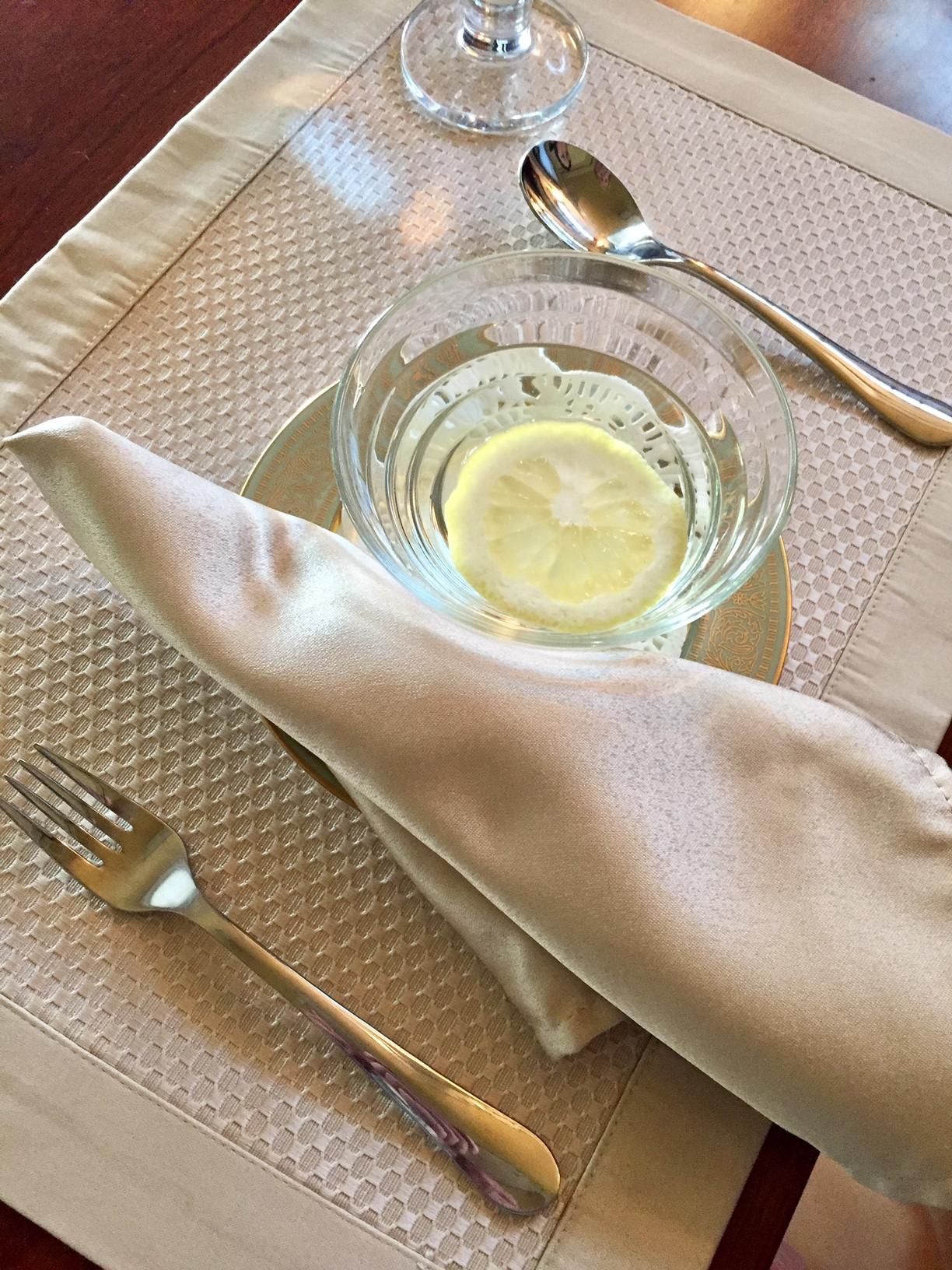
So duly, rice and Sambar with two other curries was made. At the end of the meal, Bastian in his usual style, produced crystal finger bowls with warm water and a small slice of lemon on the edge. The Tahsildar, who naturally knew nothing about finger bowls and who came from a place (Pollachi) where people drink warm water, squeezed the lemon into the water and drank it up. As soon as he left there was Bastian with a big grin on his face telling me, “See Master! What I told Master about that man?”

The interesting thing in this story is that the standards that Bastian exemplified were the standards of the British, taken from their culture. The Tahsildar was actually a man who came from the same culture as Bastian himself, yet Bastian identified with and got his own sense of significance from the standards of the British rather than from his own people. The power of indoctrination and identification with the ‘ruling class’ was very visible in plantation society where the culture of the White Sahibs was very much alive and followed to the T by their successors, the Brown Sahibs.

Not to say that all these standards were bad. Not at all. Many of them referred to manners, ways of dealing with subordinates with fairness and dignity, the importance of appearance and presentation and the power of the ‘Covenant’ that made the managers ‘Covenanted Staff’ as against all the other staff who were called Non-covenanted. But there was also the element of superiority of race, caste, and more importantly, class. Social class.

Is this your first visit here? Welcome to Indian Chai Stories!
Do you have a chai story of your own to share? Send it to me here, please : indianchaistories@gmail.com. 

My name is Gowri Mohanakrishnan and I'm a tea planter's wife. I started this blog because one of the things that I wouldn't want us to lose in a fast changing world is the tea story - a story always told with great seriousness, no matter how funny - always true (always), maybe a tall tale, long, or short, impossible, scary, funny or exciting but never dull.
You will find yourself transported to another world! Happy reading!
Cheers to the spirit of Indian Tea! 


Meet the writer: 

Mirza Yawar Baig. President, Yawar Baig & Associates (www.yawarbaig.com). Business consultant specializing in Leadership Development and Family Business Consulting. Was a planter from 1983-93 in Anamallais and Kanyakumari. Author, mentor, photographer, speaker, inveterate traveler. Working across boundaries of race, religion and nationality to bring hearts together. I was in tea for seven years and in rubber for three. Also planted coffee, cardamom, vanilla and coconut.

Friday, March 29, 2019

Language Opens Hearts

by Mirza Yawar Baig

It has long been my philosophy to live one day at a time and to try to create as much happiness for myself and around me as far as  possible. I have always held that the secret of happiness is to be thankful for and enjoy the small things in life. There are far many more of them than the big events. 

One of the first things I did when I joined the tea industry was to learn Tamil. I recall Mr. Ahmedullah, the General Manager telling me, ‘You must speak Tamil not only fluently but like a Tamilian, not like a Hyderabadi or an Englishman.’ And that is what I proceeded to do. I engaged the local school teacher in Sheikalmudi, Mr. Kannan (called Kannan Vadiyar – Kannan the Teacher) to teach me Tamil. He was a great teacher and I was very enthusiastic to learn. Not only did Mr. Kannan teach me to speak, he taught me to read and write Tamil and also taught me something of the most famous of Tamil classics, the Thirukkural.

This is a book of proverbs written by the famous sage, Thiruvalluvar who is revered for his wisdom. Thirukkural is structured into one-hundred-thirty-three chapters, each containing ten couplets, thus a total of thirteen-hundred-thirty couplets. Each couplet has seven words, four in the first line and three in the second. Amazing achievement, conveying amazingly wise advice strictly within this framework. Poetry has this power of enforcing discipline in thinking. When you are keeping to the rules of classical poetry, you must think clearly and express yourself concisely. Mr. Kannan used to read and explain them to me and I even memorized a few of them and would on occasion recite them in my speeches, much to the amazement of the audience. In six months of daily lessons, I became completely fluent and thanks to Mr. Kannan’s accent, I speak Tamil like a Coimbatore Gounder or Brahmin. Knowing the language is a window into the culture and so it was with me.

Knowing Tamil proved to be a big asset, both on the estate as it gave me a major advantage to be able to communicate with my people in their own language, and later in consulting as I now have several Tamil business families as clients. Knowledge of Tamil was also a great asset in communicating with the Chairman of my company, Mr. AMM Arunachalam, who despite being fluent in English preferred to speak in his own mother tongue, Tamil. So, when he would come to visit Ambadi Estate and visit the Suchindram temple at Kanyakumari, his wife and he would stay with us, as I was by then the Manager of Ambadi Estate. In the evenings he would sit with us after dinner and at my request, he would tell me the story of their family and their move from Burma to India and how they evolved from being money lenders to one of the leading industrialist families in India. The conversation would mostly be in Tamil with a few sprinkles of English. These evenings gave me an insight into the minds of one of the foremost business family heads and were instrumental in helping me understand the mind of an entrepreneur. Years later when I wrote my book, ‘The Business of Family Business,’ I dedicated it to the memory of Mr. AMM as we called him and to his generously sharing his life experience with me. He was a great teacher and I was an interested and willing student.

Life in the Anamallais passed like a dream. Berty Suares was the Assistant Manager on the neighboring estate, Malakiparai. And Sandy (Sandeep Singh) was on Urlikal. Both dear friends. They would come over to my place and we would spend the Sunday picnicking on the bank of the Aliyar River where on a bend in the river that passed through our cardamom plantation, I had built a natural swimming pool. I deepened the stream bed and deposited the sand from there on the near bank, thereby creating a very neat ‘beach.’ Sitting on this beach under the deep shade of the trees after a swim in the pool was a heavenly experience.

Add to it, eating cardamom flavored honey straight from the comb, taken from the many hives that I had set up in the cardamom fields for pollination. The flavor comes from the pollen of the flowers which the bees take to make the honey. Depending on where you set up your hives or where the bees go to find pollen, honey has as many flavors as there are flowers. While we lazed about at noon, our lunch would be brought down to us and we would all eat together. The joys of being a planter in the days when we had people who knew how to enjoy that life. And no mobile phones, net coverage and Wi-Fi to worry about.

If you walked down the river for a couple of kilometers you would come to the Parambikulam Dam backwaters into which this river flowed. I had built another pool there at the bottom of a waterfall, thanks to a stream that flowed through Murugalli Estate. We used to keep a boat in the dam to go fishing on the lake. There was a thickly wooded island in the lake about half a kilometer from the shore on which one could go and spend the whole day, swimming and lazing in the shade; a very welcome occupation, free from all stress. The only sounds that you would hear would be the wailing call of the Rufus Backed Hawk Eagle and the Fishing Eagle. In the evenings, the Jungle Fowl called the hour. If you stayed beyond sunset, the only danger was that you could encounter bison (Gaur) as you walked home. That encounter was not something to look forward to as I discovered one day.

Mercifully, I was walking softly, and the wind was in my face, so the Gaur was as startled as I was. He snorted, spun on his heel, and vanished, crashing through the undergrowth. I was very fortunate.
The more I spent time with myself, clearer it became that it is important to be ‘friends’ with yourself. The more you are self-aware and comfortable internally, the more you can enjoy the world outside. When you are not aware of what is happening to you inside or are unhappy with decisions you have taken, or with your own internal processes, the unhappier you are likely to be with your surroundings. The normal tendency is to blame the outer world, but if one looks within, it is possible to find the solution. One rider however, that you will find only if you seek and only if you have the courage to recognize what you see. That is where sometimes the matter remains unresolved. Not because there is no solution. But because we are unwilling to accept the solution or to implement it.

Time for another dip, then climb into the hammock and gently swing in the breeze that comes blowing over the water. Those were the days……………………

It was in this period that I was promoted and transferred from the Anamallais to Assam. I declined the promotion because Assam is a backwater and one tends to get lost there. In the corporate world it is important to be physically visible, not only visible through reports. Paradoxically if you are doing well and all your reports have nothing to make anyone concerned, you are not rewarded but forgotten. It is indeed the squeaky wheel that gets the grease, and this is nowhere truer than in the corporate world. I figured that if I went off to Assam, which is about as far as you could get from our corporate office in Chennai, I would be forgotten, and this would have a negative impact on my career.

I declined the promotion. However, since I had been transferred, I had to move out of the estate. This was a trying period because suddenly I had no specific job. I had to leave my job as the Manager on Lower Sheikalmudi Estate because that job had already been assigned to another colleague. That left me literally homeless as there were no bungalows in the Anamallais where I could live. I was ‘parked’ in Carolyn Estate in Mango Range until the company could decide what to do with me.

I was assigned a bungalow in a forest thicket, which was in a dilapidated condition. The location of the bungalow was lovely, and it was a joy to wake up to bird calls every morning. However, the house itself looked like it would collapse on our heads at any time. Of particular concern were the walls, which were so waterlogged that they had fungus growing on them in huge patches. My wife is an amazing homemaker and all her talents were put to test in this place. Out of this dilapidated house she created a lovely home which we enjoyed living in.

Since I had no regular job, I decided on doing two things:

For a long time, I had been talking about the need for systematic training of new managers. The current system in the plantations was that a new assistant would be put under a manager and what he learnt or didn’t depended on his own capability and the interest and energy of his manager and field or factory officers. If the assistant was lucky and got some people who were both knowledgeable and interested in teaching, then he learnt a great deal. If not, he remained guessing. This is a highly undesirable system, which is very time and energy intensive and does not give standard results. I had been saying for several years that there was a need for a standard text book on tea plantation management, which could be used to provide standardized training. Any additional inputs that the young man’s manager and staff could give him would only add to this, but he would not be deficient in the basics.

During my stay in Mango Range, I decided to write this book and in 6 months, I produced a 200-page Manual of Tea Plantation Management. At the time of its publication there was no such book on the market and it was a source of great satisfaction for me. My company published it as an internal training book and though it was never a commercial publication, it did get fairly wide publicity and was used by many new managers. It has since gone out of print and to the best of my knowledge, it has not been reprinted. A big lesson for me was the power of the written word and its high credibility in making your customer base aware of what you have to offer. After that book there was no way that I could be ignored, not that I feared that. I had a lot of people who I had worked with over the years rooting for me in the company.

The second thing I did was to spend a lot of time in Mango Range factory and hone my expertise in CTC manufacture of tea. I knew Orthodox manufacture as I had been Assistant Manager in charge of Murugalli factory in the Anamallais. But though I was part of the project team for Mayura factory construction and defacto Site Manager, I had never done CTC manufacture. So, I considered it my great good fortune that Mr. T.V. Verghese, who had retired as a General Manager in Tata Tea and was consulting with our company on manufacture, was a regular visitor to Carolyn. He and I became very good friends. He shared his knowledge freely and I learnt a great deal. He was a practical teacher, which meant that I got to spend a lot of time on my back on the floor meshing CTC rollers with grease anywhere on my face and body that grease would stick. I learnt all aspects of manufacture hands-on further reinforcing my belief that learning comes from doing – not from talking about doing. It was ironic that thereafter I went to Ambadi, which was a rubber plantation and never really used this knowledge, but it did come in use for writing a paper comparing Orthodox and CTC methods, which I presented at the UPASI Annual Conference in 1989.

Carolyn , Mango Range was an interlude in my career. I was marking time and waiting for some positive change to happen, and in the meanwhile I enjoyed myself. It has long been my philosophy to live one day at a time and to try to create as much happiness for myself and around me as far as  possible. I have learnt that the two are the same. You can only be happy if those around you are happy. This is true whether you are an individual, an organization, or a country. Imagine what a wonderful world we would have if instead of competing, we collaborated and shared resources. We would all be wealthier, happier, and healthier. I have always held that the secret of happiness is to be thankful for and enjoy the small things in life. There are far many more of them than the big events. If we can enjoy the small things, then we can be happy all the time. The key to enjoyment is to appreciate them and be thankful for them. The key to contentment is not amassing, material but in being thankful for what one has. The happiest people are those who are content. Content people are those who are thankful. Material wealth has nothing to do with it.

One of the things that I was very appreciative of and thankful for was the leisure that I had in Mango Range. I had no specific work except what I decided to do for myself. And I was still getting my salary. I decided to learn golf. I got a caddy from Ooty Club to come and stay with me in the estate for three weeks. His name was Frank Augustine (I used to call him Frankenstein) and he looked like a dried prawn. When he swung the club though, he always hit the ball with that sweet phut that all golfers love to hear. And the ball would travel straight like a bullet down the freeway. Whereas my club would come up with a good measure of earth and top the ball to boot. Shows that technique and not strength of the arm is what works in golf. Also, in many other things in life. Frankenstein believed in hard work – meaning, making me work hard. He set up a practice net, produced a bag of a hundred used golf balls and we were good to go. I would hit the ball into the net until I felt my arms would drop off. All the while, Frankenstein would sit on his haunches under the Champa tree that was to one side, smoking a beedi, watching me and making clucking noises. The effect of all this clucking and my swinging at the ball became clear when one day about midway in our training Frankenstein suggested that we should go and play a round at the club.

So off we went on the three-hour drive to Ooty. After a cup of tea and a sandwich, I teed off and that is where all the practice paid off. Ooty Club has very narrow freeways bordered by spiky gorse. If you didn’t hit your ball straight, you would send it into the gorse and then you may as well forget about it – you must pay to get the ball back by leaving your blood on the gorse and acquiring gorse thorn furrows in your hide. As Frankenstein continued his mother hen act, I could see the distinct improvement in my style and capability.

Another one of my joys while living in Mango Range was the time I spent with Mr. Siasp Kothawala at his lovely guesthouse called Bamboo Banks in Masanigudi. Masanigudi is in the foothills of the Nilgiris at the edge of the Mudumalai-Bandipur National Park, so there is a lot of wildlife around. You see a lot of Chital, some Gaur, and some elephant, the latter being dangerous as they are too close to human habitation and often in conflict with people. Mudumalai is also supposed to be a tiger reserve, though I have never seen a tiger in it.

My wife and I used to go to Bamboo Banks on some weekends. The gate of Bamboo Banks was an ingenious contraption. It was a bamboo pole, suspended horizontally across the road and had a plastic water container secured on one end. There was a sign for you to tug on a rope if you wanted to open the gate. The rope was connected to an overhead tank so when you tugged it, water would flow into the plastic container, which then went down and lifted the other end. All this happened while you were comfortably sitting in your car. The water would then drain out of a hole in the can and flow into an irrigation ditch and on into some fruit trees, closing the gate. Siasp was a tea planter and worked for the Bombay Burma Tea Company (BBTC). He then went into the tourism business and has done very well. We would spend lovely afternoons talking about the tea industry and the general state of the world and drinking tea. Siasp always had an angle to everything, which he would put across in a hilarious and entertaining way.

Siasp also had horses on his farm and having had tea I would take one of the horses and go riding in the sanctuary. This had its exciting moments and I recall two of the best.

One day, late in the afternoon, I was riding out of the farm and into the dry fields that surrounded it before the track entered the bamboo thickets that bordered Mudumalai, when I saw a hawk hovering in the sky ahead of me. I pulled up to watch it and saw a dove break out of cover from a hedge and head for the safety of the forest flying very fast. The hawk folded his wings and stooped coming down like an arrow out of the heavens. The dove had almost made it to the forest cover when the hawk hit it in middle of its back with a slap that I could hear where I was sitting on my horse. The dove must have died with the impact, but the hawk bore it to the ground and then holding it in its claws, looked up right and left, its pale yellow eyes scanning the world to challenge any takers. What a magnificent sight that was. The image is engraved in my memory.

As I rode on, I took a path that went along the middle of a forest glade which had scattered clumps of bamboo. After a kilometer or two, the path passed between two very thick and large clumps of bamboo and dipped into a dry stream bed and went up the other bank. I used to like to gallop this stretch and my horse knew the routine. Strangely, on that day as we came near the bamboo clumps my horse shied and stopped and refused to go forward.

This was odd behavior, but I have enough experience to know that in the forest your animal is your eyes and ears and you only ignore its signals at your own peril. I listened to the horse and turned around and then took a long and circuitous route to go around whatever it was that was bothering my horse.

As we came around, I saw what was bothering him. It was a lone male elephant which was hiding behind the clump of bamboo. Now I have no idea what the elephant’s intention was, but I was not taking any chances. My horse obviously didn’t like the idea of passing close to the elephant and if we had continued on that track, we would have encountered that elephant where the path was the narrowest and where it was bordered and hedged in by the bamboo. In case of an attack, we would not have had any escape. Lone elephants are famous for such attacks. A rather terminal situation which we were happy to have avoided.

 On one of those trips to Bamboo Banks, I saw an elephant by the roadside, a little way inside the forest. As this was quite close to the Forest Department’s housing and elephant camp, I thought that it was a tame elephant and decided to take a picture. I had a small box camera at the time in which you were the telephoto – if you wanted greater magnification, you had to go closer to the object. I got out of the car and walked almost to the side of the elephant and took a photo. Suddenly I heard someone yelling at me, his voice high pitched in panic. I looked up and there was a forest guard, a good two-hundred meters away, waving frantically at me and yelling at me to get back into the car. Since it is not an offence to get out of your car on the main road in Mudumalai, I was irritated at this man’s insistence but since I already had my picture, I returned to the car.

As we drove on and came up to him, the man waved us to a stop and still in an angry voice asked me in Tamil, ‘What do you think you are doing? If you want to die, go do it somewhere else.’
I said to him, ‘Hey! Relax. What is all this about dying? I was only taking a picture of one of your elephants. Who said I want to die?’

The man said, ‘Our elephants? That was a lone wild tusker that you were standing next to. I have no idea why he let you get that close or why he did nothing. Your lucky day. That is a wild elephant and a lone one at that. Don’t do these stupid things.’

And he went on for a while in the same vein. I was so shocked that I listened in silence. And of course, how can you get angry with someone who is only interested in preserving your life? But I still have the picture, which is very impressive.

For more please read my book, “It’s my Life”
http://amzn.to/28JpEC2

Meet the writer: 


Mirza Yawar Baig. President, Yawar Baig & Associates (www.yawarbaig.com). Business consultant specializing in Leadership Development and Family Business Consulting. Was a planter from 1983-93 in Anamallais and Kanyakumari. Author, mentor, photographer, speaker, inveterate traveler. Working across boundaries of race, religion and nationality to bring hearts together. I was in tea for seven years and in rubber for three. Also planted coffee, cardamom, vanilla and coconut.

Is this your first visit here? Welcome to Indian Chai Stories! 

You will meet many storytellers here at Indian Chai Stories, and they are almost all from the world of tea gardens: planters, memsaabs, baby and baba log. Each of our contributors has a really good story to tell - don't lose any time before you start reading them! 

Do you have a chai story of your own to share? Send it to me here, please : indianchaistories@gmail.com. My name is Gowri Mohanakrishnan and I'm a tea planter's wife. I started this blog because one of the things that I wouldn't want us to lose in a fast changing world is the tea story - a story always told with great seriousness, no matter how funny - always true (always), maybe a tall tale, long, or short, impossible, scary, funny or exciting but never dull. You will find yourself transported to another world! 

Happy reading! Cheers to the spirit of Indian Tea!

 ADD THIS LINK TO YOUR FAVOURITES : https://teastorytellers.blogspot.com/Indian Chai Stories

Saturday, February 2, 2019

Never a Dull Moment

by Mirza Yawar Baig
I was a member of the team that built the Mayura Factory in the Anamallais where I was the Assistant Manager in charge of the building project. So, I was closely associated with the project from the word ‘Go.’ The factory was built on Lower Sheikalmudi Estate and AVG Menon, my first manager, was made responsible for the project. He appointed me as his assistant for the day to day supervision of the construction. So, I became the defacto Site Manager of the project. At that time, I was the Assistant Manager in charge of the factory on Murugalli Estate which borders Lower Sheikalmudi. Murugalli factory manufactured tea in the Orthodox way and I was well versed in that. Mr. Kumaran was the Tea Maker (that is what the Factory Manager was called) and was kind enough to teach me about his art. Tea making is an art. Despite all the science and technology that is in it and more so today, it remains an art which you must see those who know it, to appreciate. Kumaran was one of them.
Mayura Factory

When the Mayura offer came, I was told that I would not be relieved from my role in Murugalli factory and that if I wanted to take the offer then I was free to do it without any additional pay or facilities. I accepted. The thought that I could refuse didn’t even enter my head. For one thing, AVG was a dear friend and my first manager. For another, it was a unique opportunity for me to learn about CTC manufacture. And much more importantly, I would be part of a new factory project, which happened in the tea industry very rarely indeed. So, though it meant practically double the hours, I did this job gladly. Mayura was unique for many reasons. For one thing, it would have a capacity to process one-hundred-thousand kilograms of green leaf per day. At a time when the average production was two-thousand-five-hundred kilograms made-tea per hectare, this was a huge figure, one that nobody thought could ever be reached.

It was the vision of Mr. K. Ahmedullah the General Manager, and Mr. N. K. Rawlley, the Visiting Agent, who proposed the theory that creating capacity would stimulate production as it would put pressure on the estates to supply the factory and so the yield per hectare of the estates would go up. Initially, nobody believed them except the Murugappa family; Mr. Alagappan and Mr. AMM Arunachalam in particular. But that was enough as they were the ones who were funding the project. Once the factory was completed, Ahmed’s and Nikoo's vision was proved right. The production of the estates went up from two-thousand-five-hundred to four-thousand kilograms per hectare. Needless to say, this did not happen by magic. A lot of people put in a lot of effort, but there is no doubt that it was the presence of Mayura that pushed us all to excel. Once again this proved to me the value of vision.

Since the Anamallais is hilly, locating a huge factory was no easy task. It involved leveling the land to create the construction site. The main building was on columns, but we still needed a level site to locate all the rest of the buildings and bays. We had two bulldozers come up from Coimbatore to do the cutting and filling of soil on the hillside to get enough level land to start building. I went down to the site on the first day that the work started. The bulldozer operators were already on their machines with the engines running. I called the leader of the team to give him instructions. He switched off the engine and came to me. I showed him from which part of the hillside I wanted the soil to be cut and where I wanted it to be moved and dumped so that eventually we would get a flat surface. He listened in silence, then handed me the key and said, “Why don’t you show me how to do it?”

I was taken aback by this obvious insubordination so early in the morning. But I took the key from him, climbed up on the track of the dozer and into the seat. I started the engine, engaged gear, and started cutting the soil. I worked for about half an hour. Then I parked the machine, switched off the engine, got off the machine, and handed the key back to the driver and walked away, all in silence. I had a hard time keeping a straight face at the look of shock on the driver’s face for having called his bluff. The long and short of this was that I never had a problem with any driver again for the duration of the land clearing stage. When the work was done, and the drivers were going back, he came to me and said, “I apologize for challenging you on the first day, but tell me where did you learn to drive a bulldozer?” I told him, “In future, before you challenge anyone, first find out what they know.”

My knowledge of bulldozers and machinery acquired in Guyana in the mines, came in very handy when later I was doing a Job Evaluation exercise in the company and had to evaluate the difficulty of each job. Knowing how to do the job yourself is obviously a big advantage and not one that most non-technical people have. My learning in this incident of the bulldozer was the fact that to build credibility it is important to be able to lead from the front. You don’t have to do people’s jobs for them. It is not even desirable to do this. But you do need to demonstrate that you know what they do and can do it if necessary. It is when subordinates get the impression that you know nothing about what they do, that it makes them nervous and lose motivation. The good ones feel a little lost. The crooks take you for a ride.

Mayura Factory’s construction was a time of learning for me. The site engineer was a wonderful elderly gentleman called Mr. D.R.S. Chary, who stayed with me in my bungalow throughout the project. He was a very well read and learned man, many years my senior but with a great sense of humor. We hit it off from the first day and became great friends. Chary taught me a great deal about constructing large buildings. I found this a fascinating time and used every opportunity I could, to add to my knowledge. On the factory site, the contractor’s site engineer was another wonderful man called Mr. Dakshinamurthy. He also became a good friend and was helpful in many ways.

Chary and I lived in the bungalow behind the tennis court. We could see the construction site from our veranda. Since Chary was a Brahmin, out of consideration for him, I had instructed Bastian not to cook any meat while he was staying with us. No meat was cooked for over six months in our kitchen. I would go to some of my other friends like Berty Suares and Taher for my meat fix.

The bungalow had a somewhat shady history in that it was supposed to have been the estate hospital in the remote past during an epidemic and many people had died in it. All this and more news was given to me by my dear friend, Kullan. Kullan had retired and his son Raman was a worker in the Upper Division. Raman used to be my companion on my treks to Grass Hills and his father became my friend. Kullan would turn up in the evenings and he and I would sit out on the veranda and he would tell me stories of these hills. The fact that I had learnt Tamil and spoke it fluently was the root cause for this and many more friendships and for my being able to have a very different relationship with my workers, from most managers. What also helped was my whole attitude of treating my workers like colleagues and not as servants. They appreciated it and returned my affection manifold. Having said all that, Kullan refused to enter my bungalow and sit in the drawing room. He looked horrified when I suggested it and insisted on sitting in the veranda. There too he refused to sit on a chair and so both of us would sit on the steps. That having been settled, both of us would drink tea and Kullan would talk.

It was Kullan who told me about the number of people who had died in my bungalow it is erstwhile incarnation as a hospital. He told me that when he was a boy there had been an epidemic (my guess is cholera) and many people were brought to the hospital but few survived. This was evidently in the rainy season, which meant torrential rain. I asked him what they did with the bodies, because cremation would have been almost impossible. In any case most tea estate workers who live on the plantations, bury their dead instead of cremating them but that also would have been very difficult in the monsoon, especially if the numbers were catastrophic as they would have been during an epidemic. “They threw them into the ravine,” he told me, in a very matter of fact manner. “Which ravine?” I asked him. “That one,” he gestured to the ravine behind my bungalow. That was, to say the least, not very comforting. However, I don’t believe in ghosts and so was not too bothered. But….

My bungalow also had the dubious distinction of having a resident demon. There was a small shrine at one end of the garden, which I was told was a shrine to Karpuswamy (literally means: Black God), who the people described as a very powerful and evil entity that needed to be placated with an annual animal sacrifice. The sacrifice itself was not done in the bungalow garden because it was done at a larger temple, but every morning one of the tea plucker women would put some flowers at the shrine.

Mr. Chary, like most highly educated Hindus, did not believe in any of this, given more to keeping to the social norms than any real belief in the religious mythology. On occasion he would sit with me and Kullan and listen to Kullan’s stories with a skeptical expression on his face. But then in the 80’s there was precious little in the form of entertainment in the Anamallais and going to the Anamallai Club in Valparai meant a motorbike ride of thirty-five kilometers one way on windy hill roads and a return late in the night with good prospects of meeting elephants on the road. While I loved to do it and have some tales to tell, it was not Mr. Chary’s cup of tea. So, most evenings we sat in pleasant companionship and talked about Tamilnadu and Tamil culture or listened to Kullan.

Some weeks after Chary and I moved into the bungalow, some rumors started to circulate in the estate to say that my bungalow was haunted, and that people had seen Karpuswamy near the bungalow at night. I saw nothing and was not perturbed by the rumors. I don’t believe in ghosts and don’t believe that anything can harm or benefit anyone except the Creator Himself. So, I slept well. Chary told me one day when he was leaving after the completion of Mayura Factory that he never seemed to sleep well in this bungalow. But I was not sure how much of that was because of some unconscious effect of Kullan’s stories and Karpuswamy rumors and how much of it was plain indigestion or some such thing. He was over sixty years old at the time, after all.

I had recently bought a used Ambassador car. Among its other attributes was the fact that it was graced with a carburetor that was cracked down the middle and was held together with a wire. Now hold on – before you go making sly remarks about Ambassadors, ask yourself, ‘which other car would still run in this condition?’ And run it did. However, it did need long hours in the workshop. In the plantations the workshop came to you, as did most other things. One night Velayudhan, the mechanic, was working on the car in my garage behind the house. He worked late into the night and promised to return the next day to complete the job. The next morning there was no sign of him and when I sent someone to look for him, the man returned and said that Velayudhan was in hospital.

I was very surprised and concerned as the man had been working in my house the previous evening and had been well and healthy. What could have happened to him for him to be hospitalized? He was a cheerful and willing worker and I had a very good relationship with him, so I was genuinely concerned for him. I went to the hospital and first asked the doctor what the matter was with Velayudhan. The doctor told me that he had been brought to the hospital late the previous night hysterical, his heartbeat racing and in a semi-conscious state. He was so bad that the doctor had been afraid the man would have a heart attack or a stroke. All this seemed to have been brought about by intense fear. He had to be given a heavy dose of sedative to put him to sleep. In short, the man had been extremely frightened by someone or something.

I went to see him, and he told me the story, which I present to you without comment.

He said to me, “Dorai, I had finished my work for the day on your car and decided to take the short cut through the tea field down the hillside instead of the main road. It was a full moon night and the footpath was clearly visible in the moonlight. As I started down the path, I suddenly heard a heavy snort behind me, like a cow sometimes makes as it is grazing. I looked back over my shoulder and saw a huge man with flaming red eyes and huge teeth. I turned and ran and then I fell down and fainted.” Some people who were going past on the main road below heard the sound of his running and then saw him fall. They picked him up and took him to the hospital. There was some suspicion that perhaps he’d hit the bottle, but the doctor denied that and said that he did not show any sign of having been inebriated. He was just very badly terrified and completely hysterical with fear.

I lived in that bungalow for two years and went in and out at all hours, but never saw a thing. That is what led to the rumor that Karpuswamy was the guard on the bungalow and guarded me. In the plantations such rumors add to your mystique and reputation. In any case, I could do nothing to refute it.

Never a dull moment in the estates.

For more please read my book, It’s my Life
http://amzn.to/28JpEC2

Meet the writer: 

Mirza Yawar Baig. President, Yawar Baig & Associates (www.yawarbaig.com). Business consultant specializing in Leadership Development and Family Business Consulting. Was a planter from 1983-93 in Anamallais and Kanyakumari. Author, mentor, photographer, speaker, inveterate traveler. Working across boundaries of race, religion and nationality to bring hearts together. I was in tea for seven years and in rubber for three. Also planted coffee, cardamom, vanilla and coconut.

Is this your first visit here? Welcome to Indian Chai Stories! 
You will meet many storytellers here at Indian Chai Stories, and they are almost all from the world of tea gardens: planters, memsaabs, baby and baba log. Each of our contributors has a really good story to tell - don't lose any time before you start reading them! 

Do you have a chai story of your own to share? Send it to me here, please : indianchaistories@gmail.com. My name is Gowri Mohanakrishnan and I'm a tea planter's wife. I started this blog because one of the things that I wouldn't want us to lose in a fast changing world is the tea story - a story always told with great seriousness, no matter how funny - always true (always), maybe a tall tale, long, or short, impossible, scary, funny or exciting but never dull. You will find yourself transported to another world! 

Happy reading! Cheers to the spirit of Indian Tea!

 ADD THIS LINK TO YOUR FAVOURITES : https://teastorytellers.blogspot.com/Indian Chai Stories