Read About Indian Chai Stories

Our Writers - in Pictures!

Tuesday, March 23, 2021

Early Plantation Days in the Nilgiris

Hello again, dear readers! Birthday month at Indian Chai Stories (we turned three!!) and family time! That's right, 'family time'. Radha Madapa**, and later her mother-in-law Vina had written about their lives as cha memsaabs, and now a third member of the Madapa family, their 'Big Chief' writes a fascinating and engaging account of his early days in tea. Enjoy your read! -Gowri

by Codanda Tata Madappa

With my children Navina & Vinod, Lauriston Estate, 1965

I was born in my grandfather's house in a coffee estate in Kodagu(Coorg). As a senior student in 1942, I participated in the Quit India Movement in my hometown Madikeri - taking part in protests, shouting slogans, demanding that the British leave India. I was a school boy of around ten years, when Gandhiji visited Somwarpet (again in Kodagu), and I had the good fortune to not only be present but also to be in the front, and he gave me an orange! 

After my graduation in the early '50s when I got a job, as fate would have it, I had to report to a Britisher in the plantations. The company I joined was called Ouchterlony Valley Estates (1938) Limited, situated at the foothills of the Nilgiris. Goodness me, the environment and weather was akin to my home district of Kodagu. The Valley was known for eye catching water falls, birds and wildlife, scenic beauty, scope for fishing and duck shooting. It was exciting indeed to hear tigers roaring on the mountain ridges during the mating season. 

With the Minkleys, Kelly Estate,1955
The property of about 15 thousand acres was once owned by Colonel Ouchterlony. Subsequently it was inherited by Wobshire and family. Due to repeated losses through the years of war, the property had to be floated as a Limited Company. Peirce Leslie Limited cornered the major shares and thus took over the management and administration, with their Head Office at Calicut, Kerala. When I joined the company, they had 1500 acres of tea and 4500 acres of coffee with factories and pulpers. Later years cardamom and pepper too. One coffee pulper was inaugurated by Lord Lytton, the then Viceroy of India, on 17/9/1877. On elephant back he was treated to Shikaar. When I joined, there were seven British Managers and one Indian called Menon. John Hamilton Wilkes was the General Manager. I was posted at Glenvans Estate and shared the bungalow with a British Assistant Manager called John Macliment. 

A beautiful, good natured horse called Lancashire was kept at my disposal so I could execute my duties. Syce was a person called Kathamuthu who was a smart fellow. Rain, cold or sunshine, off to duty exactly at 7:30 a.m. Later years when they did away with horses I bought a secondhand 3.5 HP BSA motorbike for Rs.2,000. As time rolled on, the Plantation Labour Act came into force. Labour Unions were well organised and so also staff. Those days in order to have better control over labour force“Kangani System” was there. This gave labour supervisors absolute power over labour ,i.e, apart from wages the supervisors were earning commission per head. More labour, more commission. Thus more extraction of work and turnover. Soon the government banned this system.

As anticipated, the British planters started getting back one by one. Eventually labour unrest increased with the change of management style- Harthals and demanding more wages,etc. The first Indian General Manager was appointed who was one Mr P.K. Monnappa - ex I.G of Police (Tamil Nadu, Andhra Pradesh and Karnataka) on a three-year contract.

Around this time (1962), the newly formed Indian government stopped the “Managing Agency” system and so the Peirce Leslie Plantation sector was taken over by one Mr. Jhunjunwala who in turn sold the controlling shares to one Sri Bajoria of Kolkata. Subsequently the properties' control was bought over by M/s Manjushree Plantations Private Limited of Kolkata who still manage the erstwhile O'Valley Company.

Once a group of us with local guides trekked up to the Nilgiri Peak and had a picnic. On the way up we sighted ibex, Malabar squirrels and sambar. From the top of the peak we could see the Arabian Sea. During Pierce Leslie’s days we played a lot of sports. Our club in the Valley had a tennis court and billiards. My Manager Major Keith Vaughan Arbuckle insisted that we participate in UPASI sports (an annual event). He was one of the pioneer planters and a decent type. 
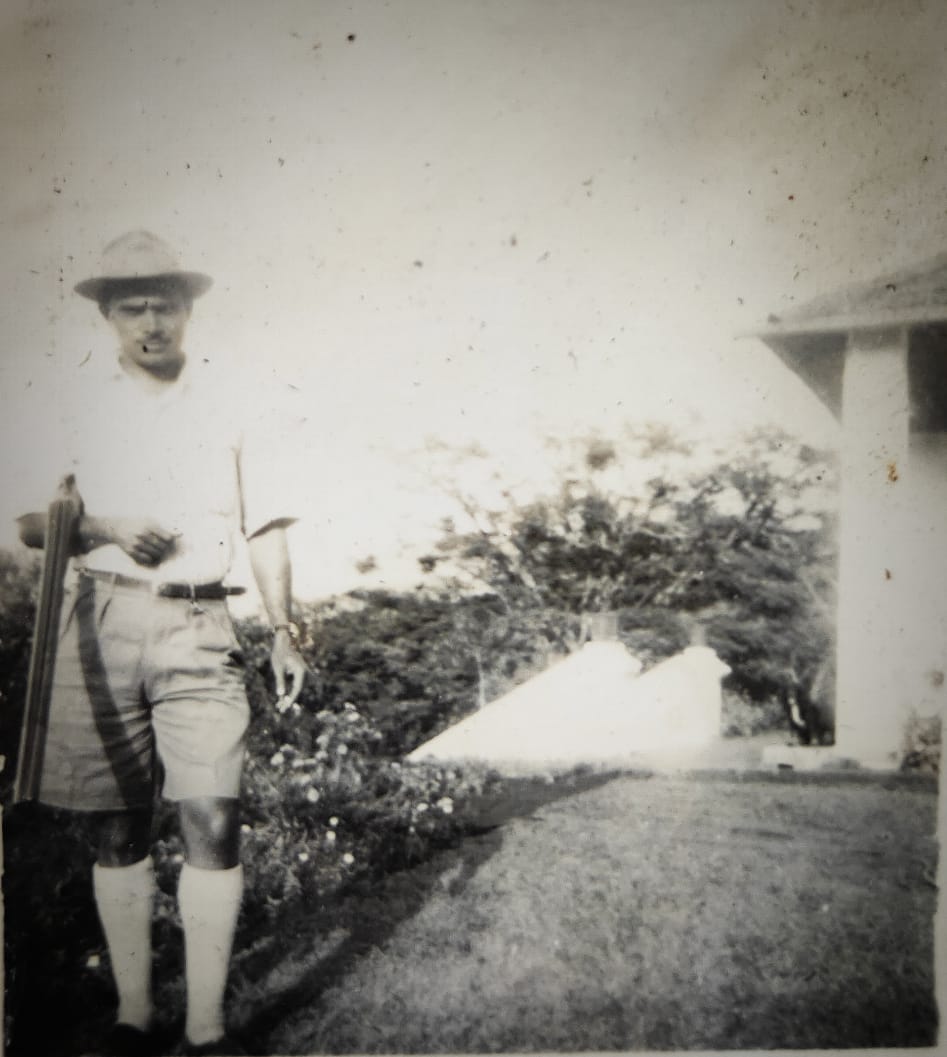
New Hope Estate, 1958
I being a shikaar enthusiast managed to bag leopard, bison, sambar, porcupine, etc. Besides, good fishing at Mukurthi Lake and duck-shooting at Begur. In my good old Ambassador car I would secure my small boat on top. Earlier days had a Ford Prefect (bought for Rs.5,600) that conveniently had a front visor (windshield) which I could open and prop my .22 gun and all I had to do was wait and watch. 

With my wife Vina ,Glenvans Tea Factory,1969
My wife disliked my “shikaar” sprees. Went on strike and turned vegetarian, which she still is! Once at night on our way back from the club there was a magnificent stag. I opened the cars visor and ever so quietly picked up my rifle which was always in the car. Stag was in my sights when my wife furiously pushed the barrel of my gun.

One Sunday, three of us, all bachelors decided we’d have an outing to Mysore (about 130 kilometres away), enjoy a good lunch and watch a movie. We travelled on our bikes. The route to Mysore is we first cross the Mudumalai Sanctuary (in Tamil Nadu) and then Bandipur Reserve(in Karnataka). Well, we had a good time in Mysore and left at around seven pm. Bandipur Sanctuary was smooth sailing. In Mudumalai my friend Madaiah who was ahead with poor headlights thought he saw a bullock-cart ahead, as he went on to overtake, to his dismay realised it was a wild tusker who turned around to attack! He abandoned his bike and ranfor his life. Ravindran who was next too had to get off his bike and flee. I being at the end of the line somehow managed to turn my bike around,and  they both jumped on my bike and we raced back quite a distance. We ended up spending the night at a temple - of course a restless night . Early next morning we headed back to find the motorbikes,one was damaged but luckily started .We raced back to The Valley to be on time for muster (morning roster call). News travelled fast and our Managing Agent (PL) sent us a telegram that read- “Congratulations on escaping from the jaws of death!”

All the factories, coffee pulper houses, bungalows staff quarters, labour lines had water supply by gravitation. Some areas of tea irrigation was also by gravitation only. Some pockets had Blake Hydram.Two of the Bungalows, Suffolk and Guynd had electricity by hydro-power only! Labour and staff worked well with me and I loved them for their loyalty. I admired the energy of the pluckers- mostly women folk moving up and down the hill.

I spent the best part of my life at the ‘O’Valley, no regrets! According to Law of Nature, what should happen will happen, and for everything there is a time to happen! While I was at Lauriston, I realised that my time was up. I returned home to tend to my property in Coorg.

I have since visited the O.V. many a time and still reminisce of the the glory days of my life in the plantations.

Meet the writer: 

Codanda Tata Madappa

Always enthusiastic and in good spirits, my father in law keeps us on our toes! A *nonagenarian who still drives to town to meet his friends or for a game of bridge. He’s always up to something- planting in his backyard or writing in his journal, planning his next outing or play acting. His sense of humour is legendary. He still hides behind a bush or around the corner to ambush his grandsons - who are mostly unfazed - but it gives me a near heart-attack!! An inspiration to us and to his grandchildren. We consider ourselves blessed to have him in our lives. - Radha Madapa 

*Radha tells me he will turn 97 soon, and this makes Mr Madapa our oldest contributor! - Gowri

**Radha wrote for Indian Chai Stories ( read her 'Darjeeling Days' here:  https://teastorytellers.blogspot.com/search/label/Radha%20Madapa and later, her mum-in-law Vina shared her delightful account of life in the O'Valley. You can read it here: https://teastorytellers.blogspot.com/search/label/Vina%20Madappa


Is this your first visit here? Welcome to Indian Chai Stories!
Do you have a chai story of your own to share?  

Send it to me here, please : indianchaistories@gmail.com. 

My name is Gowri Mohanakrishnan and I'm a tea planter's wife. I started this blog because one of the things that I wouldn't want us to lose in a fast changing world is the tea story - a story always told with great seriousness, no matter how funny - always true (always), maybe a tall tale, long, or short, impossible, scary, funny or exciting but never dull. 
Happy reading! Cheers to the spirit of Indian Tea! 

Saturday, March 13, 2021

Brewed: Heritage, Happiness and Tea

How to make a tea factory metamorphose into a world-class hotel: Nuwara Eliya, Sri Lanka, can show us the way, says Sudipta Bhattacharjee 

There is a magical quality about Nuwara Eliya, a sleepy town in the heart of Sri Lanka at nearly 7,000 feet above sea level. With its swirling mists and lush tea plantations, gushing waterfalls and stately colonial cottages, the “city of light” and “city of the plateau” (roughly translated from Sinhalese) was better known as “Little England” in colonial times.

Founded by Samuel Baker, explorer of the Nile and discoverer of Lake Albert, in 1846, it nestles in the Pidurutalagala range, the tallest mountain on the emerald isle that forms a protective backdrop to this tea county in the Central province.

We drove from Colombo to the picturesque and touristy city of Kandy and proceeded to Nuwara Eliya the next morning. The 85km ride through hilly terrain, myriad hairpin bends (that would put the 36 Ooty-Masinagudi twists and turns to shame) and a tunnel took nearly three hours. A stop at a tea factory ensured sampling of the famous Serendip brew and a conducted tour of the premises. It left us impressed enough to buy golden tips (comprising only the tea buds) before feasting our senses on the gushing Ramboda waterfalls. How I wished tea gardens in India would orchestrate such a drive to popularize our teas.

Chuckling over the Mackwoods sign on the hill, styled in a takeoff from the Hollywood sign in Los Angeles (from across the Griffith Observatory), we passed unending miles of the Mackwoods Labookellie tea estate en route. There are other tea gardens en route, but none as sprawling as Macwoods. Indeed, the drive was a throwback to the tea-bush laden hills of Munnar in Kerala, albeit at a higher altitude (6,850 feet to Munnar's 5,200).

From Nuwara Eliya, we still had another 15km to our destination, the Heritance Tea Factory at Kandapola, most of it along a steep gradient. The old factory of the Hethersett plantation, now converted into this heritage hotel, is today a much-sought-after destination. Other than some wild buffaloes, we were fortunate not to encounter any descending vehicle on that narrow track and reached the verdant grounds with a song in our hearts.

Heritance Tea Factory
Set on a meticulously landscaped garden past manicured tea gardens was the Hethersett factory of yore (the first to fetch the highest price in the world for its silver tips tea), every single one of its 54 rooms booked by tourists from all over the globe. We were accorded a warm traditional welcome: Men in white headgear and sarong put a sandalwood paste tika on our foreheads and offered cardamom, cumin seeds and sugar candy to sample with their welcome drink of spiced tea.

Manager Roshanth Selvaraj accompanied us in an old iron elevator to the fourth floor that boasts of the Flowerdew suite, offering a breathtakingly beautiful view of the landscape. Only when we could tear away our glance from the view, did we notice the crystal bowl with luscious strawberries and a bowl of cream on the table!


 The original factory parts have been retained in green while the reinforcements are in red; the dining hall table décor is neatly blended with the red-and-green colour scheme (see pictures).

Tea factory dining room with old machine parts
The décor retains the carefully preserved vestiges of the old factory. There is a huge roller beam structure above the bar, formerly the factory’s tea packing room. The gadgets for drying green leaves are visible around the restaurant and lounge (the part of the factory where the tea leaves were rolled and dried).

Tea factory bar

The lofts of the factory are now the guest rooms. Outside the premises, an entire train bogey on tracks has been recreated into a fine-dining restaurant. A waiter even manages to use a lever to simulate the chug-chug rhythm of a moving train. In the absence of a platform, hauling oneself into the bogey from ground level is quite an adventure.

With the mist swirling over the pines, and lush green tea-covered hills as far as the eye could see, this destination was a sylvan dream.

But before leaving, just as the magical mist began to envelope the surroundings, I managed to get hold of a keepsake: the Heritance spiced tea recipe!

1 litre of hot water, 2 teaspoons of tea leaf, 2 cardamoms, 1 small piece of cinnamon, 1 sliced lime, 3 mint leaves, 2 teaspoons of vanilla essence, sugar (as per requirement). Boil for five minutes. Strain and serve!


 Editor's note: You may also like to see more Indian Chai Stories from Sri Lanka: -

https://teastorytellers.blogspot.com/search/label/Bernard%20VanCuylenberg - six tales - some spine-chilling, by Bernard Van Cuylenberg, and

 
Meet the writer:

Sudipta is a career journalist who joined The Telegraph in Kolkata as a trainee in 1985 and retired at the end of August as Resident Editor (Northeast). She moved to Shillong in 1992 after her husband was transferred to Meghalaya on a three-year posting and continued to report for The Telegraph from there. She travelled to the United States on a Fulbright Research Fellowship in 2004-5 and returned to base thereafter. Her tryst with tea gardens began as a four-year-old to Kakajan in Upper Assam, where her uncle, Sukumar (Dhruba) Sengupta was posted. She and her family visited him in Majuli Tea Estate in Assam in 1970 and 1973 and by herself in December 1975 to the Dooars, when he was posted at Damdim Tea Estate. She has visited gardens in Darjeeling (where a tea tasting session was hosted for her), the Nilgiris and Munnar, Sri Lanka and hopes to share her experiences through this blog, of which she is an avid follower.

Sudipta is now adjunct professor of media science and journalism at Brainware University. 

 More stories by Sudipta here: https://teastorytellers.blogspot.com/search/label/Sudipta%20Bhattacharjee

Is this your first visit here? Welcome to Indian Chai Stories!
Do you have a chai story of your own to share?  

Send it to me here, please : indianchaistories@gmail.com. 

My name is Gowri Mohanakrishnan and I'm a tea planter's wife. I started this blog because one of the things that I wouldn't want us to lose in a fast changing world is the tea story - a story always told with great seriousness, no matter how funny - always true (always), maybe a tall tale, long, or short, impossible, scary, funny or exciting but never dull. 
Happy reading! Cheers to the spirit of Indian Tea! 

Sunday, February 21, 2021

MBAs, BOP & Acronyms

Hello again, dear friends! Sunday evening and I know we need a mood lifter right now. Well, Rajesh Thomas brings us a few much needed laughs and shares some interesting facts in this enjoyable piece! Happy reading.

by Rajesh Thomas

A thought that echoes through the hallowed corridors of the Head Offices is that what is lacking in the plantation industry is new ideas. But the sage wisdom passed on by successful old timers says that planting is primarily man management with large doses of commonsense, interspersed with attention to detail, something most of us learn the hard way and some of us when it is too late.

In one of the larger planting companies of South India, the Head Office in its infinite wisdom thought a good way to upgrade the talent pool of the mangers on the estates was to induct some of the new-fangled MBAs from the IIMs as assistant managers. Little realizing that these highly qualified MBAs may not be suited to planting and degrees do not mean a thing on the estates unless the people who hold them have an aptitude for the life. Anyway a few of these whiz kids eventually landed up for interviews.

In one of my previous stories I had mentioned about the interview process ( called the extension interview ) in the South Indian tea companies where the candidates are required to spend three or four days staying with the estate managers, wherein they are assessed of their suitability first hand.Please see 'The Interview' http://teastorytellers.blogspot.com/2019/04/the-interview.html and 'The Extension Interview' by my good friend V.R.Srikanth http://teastorytellers.blogspot.com/2019/07/the-extension-interview.html . These stories shed more light on the extension interview.

So, during the extension interview the candidates were taken to the field and the factory by the respective managers or assistant managers and learned a bit about how things work in a tea estate. Coming from the big city life on the estate was very different and fascinating to them. One of the candidates after his first visit to the factory and on his field visit with his manager, where the manager was explaining the field numbers, the young tyro asked him, "Now tell me from which fields you get the BOP grade?", leaving a rather bewildered manager to explain that all grades come from all fields.

This experiment came to nought before it started, when during the final interview, the General Manager (a very senior planter, who had spent his entire career in planting and was a few years short of  retirement) asked one of the candidates whether he had any questions for him. The only question the management prodigy had was, "All this bungalow, servants and clubs are nice but tell me how long will it take for me to sit in your chair?" leaving the venerable senior rather shaken.

Another planting company was looking for additional sources to augment income from estates and it was decided to venture into a bit of horticulture from areas unsuitable for tea cultivation within the gardens. The Bird of Paradise plant was selected to be grown, as it was thought to be hardy and the flower was supposed to command astronomical prices among the florists. Bird of Paradise flowers resemble a brightly colored bird in flight and in some places, they are also called the crane flower for the same reason.

As it was found, mentioning Bird of Paradise plant in correspondences and instructions a little tedious, it was abbreviated to BOP plant.

With work progressing on the planting of BOP plants, the D day arrived when the first lorry load of BOP plants arrived at the estate amidst a lot of excitement. The Tea Maker (equivalent of the Factory Babu in the north) burst into the estate office animatedly and exclaimed “I heard a new clone that produces only BOP grade has arrived and I want to see the plants “. The BOP plants like the MBA graduates turned into a wash out, this time due to marauding herds of Indian Gaur and troops of monkeys.

*BOP (Broken Orange Pekoe ) is a grade of tea, which is commonly used in tea bags and for every day use. The origin of the word "pekoe" is uncertain. One explanation is that it is derived from the transliterated mispronunciation of the Amoy dialect word for a Chinese tea known as "white down/hair". This refers to the down-like white "hairs" on the youngest leaf buds. Another hypothesis is that the term derives from the Chinese báihuā "white flower" and refers to the bud content of pekoe tea. Sir Thomas Lipton, the 19th-century British tea magnate, is widely credited with popularizing, if not inventing, the term "orange pekoe", which seems to have no Chinese precedent, for Western markets. The "orange" in orange pekoe is sometimes mistaken to mean the tea has been flavoured with orange, orange oils, or is otherwise associated with oranges. However, the word "orange" is unrelated to the tea's flavor.] There are two explanations for its meaning, though neither is definitive:

The Dutch House of Orange-Nassau, now the royal family, was already the most respected aristocratic family in the days of the Dutch Republic, and came to control the de facto head of state position of Holland. The Dutch East India Company played a central role in bringing tea to Europe and may have marketed the tea as "orange" to suggest association with the House of Orange.

Colour: The copper colour of a high-quality, oxidized leaf before drying, or the final bright orange colour of the dried pekoes in the finished tea may be related to the name. 


Meet the writer:
 Rajesh Thomas introduces himself:
"A second generation planter. Born and grew up in the planting districts of Southern India. Started my career in the High Ranges and Annamallais Planting Districts for twelve years. Had a stint in Africa for two years. Since 2009 been planting in the Nilgiris.


Read all of Rajesh's stories at this link: https://teastorytellers.blogspot.com/search/label/J.Rajesh%20Thomas

ADD THIS LINK TO YOUR FAVOURITES : https://teastorytellers.blogspot.com/Indian Chai Stories.
Happy reading! Cheers to the spirit of Indian Tea! 
 Is this your first visit here? Welcome to Indian Chai Stories!
Do you have a chai story of your own to share?  

Send it to me here, please : indianchaistories@gmail.com. 

My name is Gowri Mohanakrishnan and I'm a tea planter's wife. I started this blog because one of the things that I wouldn't want us to lose in a fast changing world is the tea story - a story always told with great seriousness, no matter how funny - always true (always), maybe a tall tale, long, or short, impossible, scary, funny or exciting but never dull.
 Happy reading! Cheers to the spirit of Indian Tea!


Sunday, February 7, 2021

Here Comes the Bride!

Hello, friends! Here is another delightful read from Sarita Dasgupta. I'm sure it will brighten up your Friday evening!

by Sarita Dasgupta

Truth be told, I had not wanted to marry a tea planter. Having grown up as a ‘tea’ child, the grass was definitely greener on the other side – the city. I worked for a while as a trainee copywriter at an ad agency in Kolkata and then as a receptionist at a five-star hotel, trying out both to see which I liked better. Of course, the former won hands down, but then I decided to apply for a scholarship to do my Masters in English at Oxford.

Fate intervened in the form of a certain young tea planter, and within three months of our meeting, we were married, and I was a tea memsahab!

Although slipping into the life of a tea memsahab is perhaps much easier for a tea ‘baby’ than a girl from any other background, it is not without its pitfalls!

When I got married, I didn’t know how to cook. This my husband didn’t believe because he had the vague impression that every woman knows how to cook. Fortunately for me, he had a decent Cook, though I heard later that this individual had planned to leave if I threw my weight around too much. In fact, the cake he baked to welcome me had a rather long message iced on it: “Treat your servants well and they will serve you well.” In the act of cutting the cake, I paused to read the rather long and unusual message (for a wedding cake!) iced all around it. Thank goodness I passed muster, and he stayed on!

One Sunday, when the Cook had gone to the weekly market to buy vegetables, some friends landed up and asked us to join them on a picnic. My head reeled! What could I take for the picnic? Somehow, I managed to make a fish curry (the gravy was as thin and runny as water!) and got the Bearer to boil some rice. Both were edible enough, though I did get a speaking look from my husband when he saw the runny gravy. He realized I had spoken the truth when I’d told him that I couldn’t cook.

It was after this incident that I decided I had to learn to cook. I soon realized that every curry the Cook made tasted the same because he used the same spices for every dish! I leafed through the recipe books I had been given as wedding gifts by helpful family and friends, and tried to teach him, and myself, some dishes.

When I suggested that we try something new, he looked down his nose at me loftily, and pronounced that he had cooked for this sahab and that memsahab, none of whom had had any complaints. All the people he named were conveniently retired and gone, leaving me with no way of corroborating his claims, but I made a tactical retreat for the time being.

I renewed my efforts with great diplomacy and eventually got him to try out new dishes, mollifying him by lavishing praise on his efforts. Eventually, he became quite a virtuoso!

After a few years, he contracted TB and had to be excused from work for three months, during which time I made sure he had a glass of milk and an egg every day, and generally looked after him. Once he was cleared to re-join work, the doctor warned him off alcohol, and, for a few years, he heeded that warning.

Alas, when my husband got his billet at Attareekhat Tea Estate, in Mangaldai District, the Cook took up with a woman who brewed and sold bootleg liqour. He started drinking again, as a result of which, not only did his health suffer, but so did his cooking! After quite a few talking-tos and warnings, much as I was fond of the man, I had to give him an ultimatum – he either gave up alcohol or stopped working with us. Unfortunately, he chose alcohol, and so, much to my sadness and regret, we parted ways after fifteen years.

                                        **************************************************

 An ordeal I still remember was at a cocktail party I attended as a very new bride. It was held in honour of one of the company’s Directors who was visiting the estates. He was a fatherly gentleman (I think one of his daughters was my age) who kindly asked me how I was settling in, and how I spent my time. To my horror, my husband’s boss’ wife, who is a very dear friend today, but whom I could have happily murdered that evening, told him I could sing! Obviously, the gentleman asked me to sing a song.

I tried to demur, but I was drowned out by words of encouragement from the others present, so not wanting to be unsporting, I reluctantly agreed. With a battery of eyes turned expectantly on me, and my horrified husband looking like a hunted animal desperately seeking a place to hide in, I felt my throat close up. As the silence grew longer, I managed to gulp, clear my throat, and start singing a Hindi song with trembling lips and voice. Fortunately, my voice settled after the first few bars, so that I could give a creditable performance, but my lips, and limbs too, kept trembling till the very end. The Director said kindly that I had sung a difficult song very well, and there were encouraging smiles and applause from the others present. Ever since that occasion, whenever I was asked to sing, my husband would have that same hunted look!

Bishnauth Gymkhana Club, Bihu Nite 2009
 

I was barely married for three weeks when the big New Year’s Eve bash was held at East Boroi Club. As we were at Halem Tea Estate, where the club is located, I was asked to help with the decorations and other preparations. It was all great fun and I was really looking forward to my first New Year’s Eve with my husband.

The evening was going really well till a rather tipsy but persistent man kept following me around asking for a dance. My brand new husband was livid and looked as if he was ready to bash the chap’s face in, although the person was a senior (though from a different company). Before a contretemps could occur, a senior planter saw what was happening and stepped in, firmly leading the man away. Thanks to him, I managed to avoid the unpleasant experience of getting on the dance floor with a tottering, tipsy partner on my very first New Year’s Eve as a tea memsahab.

We went on to become good friends with the man in question (who was rather nice when sober) and his wife.

                                  *****************************************************

Three months after our wedding, my husband got transferred from Halem to Monabarie Tea Estate. The bungalow we moved into was previously occupied by a bachelor, so I wasn’t very surprised when I was told that there was only grass growing in the kitchen garden. Imagine my puzzlement when, instead of grass, I saw some kind of plant growing all over the place. The gardeners exchanged shifty looks when I asked them what the plant was, and shuffled their feet in discomfort. Concluding that it was some kind of wild plant they couldn’t identify, I told them to uproot all of them and prepare beds for the vegetables I planned to grow.

It was only later, when I got my leg pulled by others on the estate, that I realized what kind of ‘grass’ was growing in my kitchen garden!

When we got married, my husband had just completed three years of service, so he hadn’t been eligible for a car loan till then. His trusty old motorbike didn’t have anything for a pillion rider to hold onto, so obviously I had to hold onto him whenever we went out together. While passing by workers or clerical staff on the estate’s roads, he would hiss at me to remove my arms from around his waist or my hands from his shoulders. I couldn’t understand why he was embarrassed. I was his wife, after all!

On one occasion I was sitting sideways because I was in a sari, so when we were going past a group of workers and he, predictably, told me to remove my hand from his shoulder, I flatly refused, telling him roundly that his wife’s safety should matter more to him than his misplaced sense of propriety!

I’m sure he was very relieved when a couple of months later, his loan application was approved and we became the proud owners of a black Ambassador bought from his Burra Sahab who was retiring from service. The car had an illustrious history, as it had first belonged to the Visiting Agent of the Company!

Perhaps that’s why it was temperamental – having belonged to senior people, it didn’t relish being used by us plebeians! 

                                       *******************************************************

When we got married, my husband had a beautiful dalmatian who had belonged to his father. When my father-in-law passed away, my husband brought him to Assam. This lovely dog was great company for me on my walks within the estate. Most of the workers passing by on their way home from work just glanced at him warily and gave him a wide berth, but one evening, a woman screamed, “Leopard! Leopard!” and started running. The other workers took off too. I thought she had really seen a leopard (not uncommon in the tea estates) and whistled to our dog, who had bounded after the screaming woman, no doubt thinking it was some kind of a game. He came lolloping back to me, and keeping a sharp eye out for the leopard, I started walking home as fast as I could. When I recounted the story to my husband later, he gave a shout of laughter and said that our sweet dalmatian had been mistaken for a leopard because of his spots!

After that, I made it a point to reassure passing workers that he was my dog, and not a leopard before any nervous person among them set up a hue and cry!

*** Towards the end of my first year of marriage, our daughter was born, and I transitioned from Bride to Mother… and that, as the saying goes, is a whole other story!

Meet the writer: Sarita Dasgupta

Sarita enjoying a warm cup of Kawakawa tea in New Zealand. 


Read about it here
 
"As a ‘chai ka baby’ (and grandbaby!) and then a ‘chai ka memsahab’, I sometimes wonder if I have tea running through my veins! 

I have been writing for as long as can remember – not only my reminiscences about life in ‘tea’ but also skits, plays, and short stories. My plays and musicals have been performed by school children in Guwahati, Kolkata and Pune, and my first collection of short stories for children, called Feathered Friends, was published by Amazing Reads (India Book Distributors) in 2016. My Rainbow Reader series of English text books and work books have been selected as the prescribed text for Classes I to IV by the Meghalaya Board of School Education for the 2018-2019 academic session, and I have now started writing another series for the same publisher.
Is this your first visit here? Welcome to Indian Chai Stories! 
Do you have a chai story of your own to share? Send it to me here, please : indianchaistories@gmail.com. My name is Gowri Mohanakrishnan and I'm a tea planter's wife. I started this blog because one of the things that I wouldn't want us to lose in a fast changing world is the tea story - a story always told with great seriousness, no matter how funny - always true (always), maybe a tall tale, long, or short, impossible, scary, funny or exciting but never dull. You will find yourself transported to another world! 

 
Happy reading! Cheers to the spirit of Indian Tea!

ADD THIS LINK TO YOUR FAVOURITES : 
https://teastorytellers.blogspot.com/


Monday, January 18, 2021

Company Dak

 by Suresh Bakshi

Hello again, dear readers! I'm happy to welcome Suresh Bakshi to Indian Chai Stories. Here are two delightful pieces he has written from a visiting "company sahib's" point of view. Looking forward to reading many more tales from you, Suresh! 

The Clarification 

None of us noticed the expenditure being debited under CAT Account; presumably because the tea estates were going through an unusual year of high profitability and the expenditure so debited was relatively insubstantial. Till of course the boom subsided and cost control became the operative word. None of us in the Head Office knew anything about this 'CAT account. 

Coats and Trousers ? - uniforms for the hospital staff perhaps - Cutters and Tools? Carpenter and Timber? Coal and Tar? These were some of the names the abbreviations suggested.

 Matters of import necessitated a visit upcountry, and after visiting the tea growing areas and the factory, Tim Monroe - the Estate Manager - and I sat in the office. I mentioned to him the decline in prices, the stagnant crop situation, the increase in both labour and material costs and that the Board, polite as ever, had nonetheless made it clear that profit projections had to be realised. We mulled over various problems and finally agreed that profits as budgeted could be achieved by effecting savings on non essential expenditure.

After the day's work was done Tim and I were in the Bungalow, he enjoying a whisky soda and I a beer and in passing I mentioned, ' Forgive my ignorance Tim', I said 'In all these many years its only now that I have learnt of the CAT Account. What expenses are these - Would you be knowing off hand ?!

A puzzled look came over him and he hummed as he thought and took some time to answer. "Oh the CAT Account - expenditure for the milk and the fish - for the cats in the food-grains godown. They look after the rats you know".

"Oh come Tim," I said with disbelief "surely we can't be spending so much on fish and milk for the cats that eat the rats." Tim said he would check with the Head Clerk and clarify before my departure from the estate.

I stayed with Tim and his wife Bessie for three days and was served the most delicious milk based puddings and the most delectable and varied selection of fish dishes each day for lunch and dinner. 


The Receiving End

I am emptying my office desk now; retirement has finally come. Some files have letters seen by none than me. Very private and confidential. Those not required by my successor are best destroyed; of this I think I will be the sole arbiter - I opened the file and I will be its destroyer. One is an old file opened some 30 years prior, the cover a mellowish brown and the papers darkened by age and by the gloom of their preserve.

Oh the naughty indescretions! These secrets are best destroyed and in they go to the shredder. I am about to destroy this particular letter but reader you may wish to share its contents. Old Tom Mackintosh of Morabund Tea Estate - dead for some years now, and the estate too sold. He had addressed it to me by name :

" I have to confirm my telegram of today's date reading 'Most urgent airfreight one dozen Aersol Insecticide Bombs, overrun by cockroaches'.

The above are required immediately to control the hoards of cockroaches and fleas which infect this Bungalow The condition of the cook house and surrounds is disgraceful. There is no excuse for the waste,ashes and debris of many months being left in the back compound. A tractor trailer has been working for a whole week and the area remains half cleared. Scavening dogs are in permanent residence.

A new kitchen range (Ray Burn) is required, the old stove being nothing less than a collection of burnt scrap metal.

The bungalow requires considerable repair. Many of the door choukats are rotted inside, only the paint and varnish holding them together.

The hollow spaces left by the rotten wood work and various holes are alive with cockroaches - Sunday's bag amounting to half a kerosene oil tin full. Four cold weather dresses which my wife left out to air last Monday were all eaten by Tuesday - some £50 worth in one night.

The previous Manager has left his trunks etc. locked up in the Bungalow godown, the key for which has been removed by his bearer, whereabouts unknown. Will you please give your immediate consideration and arrange immediate supply.

In conclusion may I remark that it would be a pleasure to be transferred to a bungalow that is well kept. Over the last two years my wife has been forced to assume the role of an unpaid char woman, a character part that is not appreciated."
I beg to remain
your faithful servant 
(TOM) MANAGER"
 
The letter has various exclamation marks but in my hand written notes on the side, sanction had been accorded for the stove and the aerosol cans airfreighted within the week: a notation on the letter reads : 'Wait till the hordes of elephants come in October.' I intend not destroying some letters and will share the many dilemmas faced over the years with readers. 
 
 Meet the writer: 
 
Suresh Bakshi

Born on 15th June, 1943. Studied in Joseph's Academy, Dehradun and St. Stephens College, Delhi. Worked for 28 years in MacNeill and Barry, MacNeill and Magor and The Assam Company (I) Ltd. Began his second career with Welham Boys' School, Dehradun, from where he retired in 2003 as the Senior Tutor and finally for a brief period as the Principal. His interests include birdwatching, gardening. He is passionate about reading. He has had his articles published in the Statesman, Hindustan Times and The Assam Tribune, amongst other periodicals. His wife Reeti is also a keen gardener and has many other interests. Their two children, Diya and Vikram, are both settled in the U.S.A. 

Is this your first visit here? Welcome to Indian Chai Stories!
 
Do you have a chai story of your own to share?  
Send it to me here, please : indianchaistories@gmail.com. 

My name is Gowri Mohanakrishnan and I'm a tea planter's wife. I started this blog because one of the things that I wouldn't want us to lose in a fast changing world is the tea story - a story always told with great seriousness, no matter how funny - always true (always), maybe a tall tale, long, or short, impossible, scary, funny or exciting but never dull.
 
Happy reading! Cheers to the spirit of Indian Tea!

Friday, January 1, 2021

Playing 'Goodwill Ambassador' in Margherita

A very happy New Year to all of you, dear readers! I'm delighted to share another charming story from Murari Saikia today!

It was early March ’84, a balmy spring Sunday morning in the salubrious climes of Margherita. I had just returned from the factory; manufacturing for the weekend done and dusted and the factory locked and sealed.

I was lounging in the ‘jali’ verandah trying to make up my mind on whom to ‘raid’ for some beer and lunch and while lost in my thoughts, I heard someone addressing me from beyond the porch.
‘Sir, sir!'
Peering out, I could make out it was my third Tea House babu, standing a little away from my vehicle.

He looked quite distraught, so I asked him what was the problem, and the man blurted out in Assamese, ‘Sir, my wife is expecting and I had taken her to the hospital, the doctor is away and the sister says that she’s to be transferred to Digboi AOC hospital. The ambulance has already gone out with some patient, we don’t know when it will return!! Sir, my wife’s case is urgent. Emergency, sir’.

I knew what was coming next; he had come to request me to help him with my car - it does happen at times, especially in situations like the one my poor staff was in! I told him to fetch Dhaniram driver and that he should be ready to move, ASAP. The babu bolted and in a short while, Dhaniram was standing outside, to take my instructions.

I told him in the usual bagan lingo, to take the babu and his wife to the AOC hospital and return as quickly as possible after dropping them off, adding that I had to go out, so he’d better hurry back!!

Dhaniram left with my trusty steed - the ubiquitous Ambassador - while I bid adieu to my plans of going out for beer and lunch. I ambled off for a bath and that done, sat down comfortably in the jali verandah with my legs perched up on the center table, a book in hand and a mug of chilled beer by the side. Lunch would have to be a mish-mash of whatever was available in the fridge. The day drew on, but, Dhaniram had not returned, it was past three in the afternoon. There was no means to find out what was happening either. Thinking that he’d be in shortly I went off for a nap. Dhaniram was one of the trusted guys and he drove well too, I reassured myself.

It was past twilight, but, no sign of Dhaniram or my car…I was beginning to get worried while a lot of thoughts plied through my head. Time ticked on, and I realized the other lads and I would not be able to get to Digboi club in time for the Sunday movies either, none of the other Assistants had any conveyance (four wheeled types), I was the only guy with a vehicle, and the other chaps depended on me!!!!

After another nerve racking hour for me, I could see the headlamps of a vehicle at my gate, and as the car drove up the short driveway, I realized it was my car, in one piece; as good as she was when driven out in the morning!

As Dhaniram alighted I was about to bombard him with a mouthful. He disarmed me with a toothless grin under his handlebar moustache, and with a flourish brought out a folded piece of paper, ‘from the babu’. On my query as to why he was late, Dhaniram in his own way informed me that 'the babu requested him to wait, and he had to take the babu to the market to fetch some things, and babu has explained everything in this letter. I was fuming at the undue liberty my staff member had taken and mentally made a note to ‘give it to him’ at some point of time.

Dhaniram stood by, while I was seething in anger as I read the note which went thus:

“Most respected Sir,
I take pleasure in bringing to kind notice that wife has fine baby boy child. 
I beg your kind pardon for not releasing Dhaniram and vehicle quickly, I was without help and movement. Kind Sir, I thank you deeply, my wife also. Sir, the baby would not be there without you. 
Your ever obedient,
Shri……” 

My wrath vanished in a jiffy after reading the note...the baby would not have been there without me!!

As they say, it’s 'cha ki baat' - it could only happen in a tea garden!!

Meet the writer:

Murari Saikia
I was born in Dibrugarh in 1959 and grew up in Shillong. After finishing school from St. Edmund’s College (School Dept.), Shillong in December 1975, went off to Delhi University and graduated from Ramjas College in 1979. Joined FSL (Nestle) around mid-79 and was in Calcutta for a short while and thereafter joined tea in 1980-81 - almost by accident!! 

After a career spanning 36 years in the plantations of McLeod Russell & the Luxmi Group, I retired from the gardens in 2017. But, the love and the lore of tea have not left me. I am still actively involved with the industry currently with Parcon (India) Pvt. Ltd as a Visiting Advisor. 

It’s always a pleasure visiting the gardens and meeting up with some very good old friends who have weathered the storms together, and as always it’s also a treat to meet the younger generation of planters and get to learn a thing or two from these lads too, while throwing back the sundowners!!


Is this your first visit here? Welcome to Indian Chai Stories!
 
Do you have a chai story of your own to share?  
Send it to me here, please : indianchaistories@gmail.com. 

My name is Gowri Mohanakrishnan and I'm a tea planter's wife. I started this blog because one of the things that I wouldn't want us to lose in a fast changing world is the tea story - a story always told with great seriousness, no matter how funny - always true (always), maybe a tall tale, long, or short, impossible, scary, funny or exciting but never dull.
 
Happy reading! Cheers to the spirit of Indian Tea!


Friday, December 18, 2020

A Christmas To Remember

Hello, again, dear readers! I'm delighted to welcome Sudipta Bhattacharjee to Indian Chai Stories. Her story will make you smile even as you wipe a tear from your eye: it's all about what makes Christmas really special -- family, love and sharing. 

'There was an aura about Christmas in Kolkata...but I got my first glimpse of a real Santa Claus in a tea garden in north Bengal's Dooars !'  

There was an aura about Christmas in Kolkata, possibly induced by my schooling at La Martiniere, where 'carol evening' was an event to cherish just before the school closed for the winter vacation. The midnight Mass at St Paul's Cathedral, the festive mood on Park Street and plum cakes from Nahoum's made the occasion memorable.

But I got my first glimpse of a real Santa Claus in a tea garden in north Bengal's Dooars and had the joy of opening my first gaily-wrapped Christmas present from under a tree at the Damdim Tea Estate Club in 1975. The joy of that occasion is imprinted indelibly in my mind.

The 45-minute flight from Kolkata to Bagdogra in December offers a view of the snow-capped Himalayas and in those days, sumptuous meals were served even on short-duration flights. My cousin Joydeep, a wee bit older than me and a class senior, was returning to his parents in the tea garden from Mayo College, Ajmer, and I accompanied him from Kolkata. Two young teenagers enjoying their first flight on their own, a joyous Christmas break from boarding school, with a new class to look forward to on our return. 

The late Tanima Sengupta, wife of Damdim Tea Estate manager late Sukumar (Dhruba) Sengupta, with her son Joydeep and niece Sudipta (the author) in the bungalow garden on Christmas eve, 1975. Don't miss the roses, Tanima's pride! Pix by Sukumar (Dhruba) Sengupta, captions Sudipta Bhattacharjee

Damdim was picture-perfect

My uncle, Sukumar (Dhruba) Sengupta, worked for the Tata-Finlay garden at Damdim and was at the airport with my aunt Tanima to pick us up. The drive to the garden near Malbazar was picturesque, especially with the tea belt stretching out for miles on either side.

Damdim was picture-perfect, the manager's bungalow set in sylvan surroundings. My aunt's green fingers were much in evidence; winter blossoms adorned the flower beds around the lawn and much to our delight, there was a tennis court adjoining the swimming pool on the grounds. My cousin and I both played tennis in our schools and were delighted to be able to practise before the American-style championships to be held at Chalsa that week. 

Joydeep and the author (Sudipta) take a break after a practice match on the tennis court of Damdim Tea Estate in Dooars,  West Bengal, in December 1975. Photo by planter late Sukumar (Dhruba) Sengupta, Joydeep's father, who was the garden manager at the time
I had lost my mother to cancer on Christmas eve the previous year, and my uncle and aunt were both very caring, helping me heal as the anniversary of the greatest loss of my life drew close. To keep me from brooding, my aunt asked me to accompany her to the club as she made arrangements for Christmas. I helped her pack the presents for children, as well as prizes for games. Stalls were set up, the club was readied for a grand party and my spirits imbibed the joyous ambience.

Almost simultaneously, we headed for Chalsa every morning for the tennis meet. My cousin, an excellent player already, won the singles final easily, while I got a tome of the Webster's dictionary after winning the girls' doubles. It was the only 'book' prize I ever earned for sports (the others are usually trophies), so I have preserved it to this day.

On the last day of the tennis tournament, there was to be a party. The young boys and girls who had met for the first time at the contest were looking forward to the social. As we headed back to Damdim to change and return, our car met with an accident on the hilly terrain. We walked to the nearest tea garden, whose manager was courteous enough to let us sit while another car came to pick us up, but we had to miss the party.

So it was only in the fitness of things that I got to experience a wonderful Christmas at Damdim's Club. We reached the venue on Christmas to find a fairytale setting. And then came Santa (later I learnt it was the manager of the neighbouring Rungamuttee Tea Estate) roaring his ho ho ho and ringing a big brass bell! He took the children on his lap and handed them the large gifts I had helped my aunt pack so beautifully. After all the children of the garden staff got their Christmas presents, he beckoned me. I hadn't expected a gift as I wasn't really a 'garden child' but he handed me an oblong box and patted my head as he wished me a Merry Christmas.

I tried my hand at the various stalls set up on the ground and won a bottle of pineapple jam at the hoopla! The fete-like atmosphere culminated in a Christmas party where the elegant ladies and dapper men danced their way into the night. We youngsters merrily shook a leg too!

On returning to the bungalow, I opened my gift. It was a Scrabble, much to my delight. I tentatively picked up two of the wooden alphabets, face down: an M and an A. I knew my mother was blessing me from heaven. I have the Scrabble board and every one of those alphabets still. 

After all, that Christmas gift from a distant tea garden ultimately made me a wordsmith!

-- Sudipta Bhattacharjee 

Meet the writer:

Sudipta is a career journalist who joined The Telegraph in Kolkata as a trainee in 1985 and retired at the end of August as Resident Editor (Northeast). She moved to Shillong in 1992 after her husband was transferred to Meghalaya on a three-year posting and continued to report for The Telegraph from there. She travelled to the United States on a Fulbright Research Fellowship in 2004-5 and returned to base thereafter. Her tryst with tea gardens began as a four-year-old to Kakajan in Upper Assam, where her uncle, Sukumar (Dhruba) Sengupta was posted. She and her family visited him in Majuli Tea Estate in Assam in 1970 and 1973 and by herself in December 1975 to the Dooars, when he was posted at Damdim Tea Estate. She has visited gardens in Darjeeling (where a tea tasting session was hosted for her), the Nilgiris and Munnar, Sri Lanka and hopes to share her experiences through this blog, of which she is an avid follower.

Sudipta is now adjunct professor of media science and journalism at Brainware University. 

 More Christmas stories here: https://teastorytellers.blogspot.com/search?q=christmas

Is this your first visit here? Welcome to Indian Chai Stories!
Do you have a chai story of your own to share?  

Send it to me here, please : indianchaistories@gmail.com. 

My name is Gowri Mohanakrishnan and I'm a tea planter's wife. I started this blog because one of the things that I wouldn't want us to lose in a fast changing world is the tea story - a story always told with great seriousness, no matter how funny - always true (always), maybe a tall tale, long, or short, impossible, scary, funny or exciting but never dull. 
Happy reading! Cheers to the spirit of Indian Tea! 


Sunday, November 22, 2020

Traditions'r'Us

Still haven't recovered from the post-Diwali blues? Christmas will be here soon, and here's some cheer for all our readers - a new post by a new writer! We've 'celebrated' family over the last few weeks at Indian Chai Stories, and now it's time for friends. One of our well loved Christmas stories on this blog is Rajesh Thomas's account of what it felt like to play Santa Claus. Today, Kamran Mohsin tells us what it was like to be his Man Friday at that same Christmas celebration. Enjoy your read!

Traditions 'r' Us 

by Kamran Mohsin

The High range has had many glorious traditions and one such tradition is the children’s Christmas party at the Club. Two assistant managers are randomly chosen, one would be Santa & the other his man Friday. There would be a grand entrance where Santa & man Friday would come swooping in & since the children were still children in those days & not the ‘glued to the screen PUBG / Mine craft playing wizards’ that they are today; they would return home with a treat & a present (from their parents of course) and a big smile. For them, it was a day full of laughter & cheer, watching ‘Simba the white lion’ and it was something they looked forward to every year. It was their big day at the club. The club on that day was full of ladies, mostly young mothers & their children. Knick knacks, balloons, and party poppers could be found all over the place. Being from the same planting district & more dangerously, the same company, we knew them all & they knew us. A cock-up here, therefore, was not an option.

The task at hand was quite simple. Make a grand entrance, wish everyone merry Christmas without scaring the bejezuz out of the little children, give them the treats & presents & pose for a few photographs (of which I have none unfortunately) & get out while your dignity was still intact. It was the man Friday’s job to hand over the presents to Santa & Santa’s job to hand over that presents to the children. One by one.

But life is not so hunky dory & so this is where the twist comes in. 

The reward for partaking in this fanfare and putting on that fancy dress & making a mockery of yourselves would be a bottle of rum. Old Monk, no less! Furthermore, as per tradition, that bottle of rum was to disappear between Santa & his side kick before the fanfare started! And as per another tradition of the high ranges, they were both expected to complete the above task, no matter how intoxicated they were & finally after it’s all over, get back to their estates in one piece.

I never knew Santa had a man Friday until I was cherry picked to become one and my good friend Rajesh was to be Santa himself. Which was great for us because 1) we both got half a day off from the daily rigmarole of the estate & more importantly, 2) free booze, DUH!

So, on the designated day, both of us arrived at the club on our steeds, straight after lunch. Bang on time, as usual, in keeping with another tradition in the high ranges. Punctuality.

We were given a club room all to ourselves where we would make the monk disappear & also change into our outfits, all while waiting for our ride to come pick us up before our grand entrance into the club. But I am getting ahead of myself.

We had the happy hour to celebrate first & the ‘old monk’ was staring us in the face. Between the two of us, Rajesh was a seasoned hand, while I was still finding my feet. But booze was never wasted, free or otherwise. Another High Range tradition! I know I had a couple of big swigs & was on the wrong side of tipsy while Rajesh, Rajesh had the rest of the monk all to himself and handled it like a pro. 

Like that seasoned boxer who tires his opponent out by soaking in all he can throw at him & then when the opponent has no more to give, our man delivers a tight right uppercut & seals it with a left hook. In no time I was happy where I was but Rajesh was happier still. In this happy state of ours, we began attempting of get into our fancy dress. 

Edmund & Tenzing must have had an easier first attempt, I can promise you that. Rajesh was into his Santa suit eventually & I don’t recall what I got into. If we knew any better, we should have gotten into our suits before saying hello to the monk. But being young & courteous assistants we didn’t want to keep the old chap waiting. Another high range tradition upheld by the young guns. Courtesy.

Now, how we finally got into our costumes is a blur. And so is the time when they handed over a flimsy bicycle for us to ride & make our grand entrance in. One lousy push bike between the two of us! I mean, we knew there were budgetary restrictions but this took the cake. I could swear it was a jeep and we were driven into the club but Rajesh insists it was a bicycle.

Apparently, I rode it & he was sitting behind me, hanging on tight for dear life! Anyhow, it’s been 25 years & you can’t blame us for not remembering the details. So off we went. Crossed the club cattle grid and all! So far so good.

And then I have some faint memories of lying flat in front of the kids on the club portico. Thank god for the balloons lying about that cushioned our unceremonious dismount. The kids found that amusing to say the least. So we made our grand entrance with a ‘bang’ then!

Eventually, I found myself in the club lounge where a small stage was set up upon which Santa would do the honors. Happy hour was over, now we had to deliver, Santa & I. Speaking of Santa, he was nowhere to be seen after we ‘hit’ the portico! A search party was sent to gather Santa and carry him to the stage. He seemed in good ‘spirits’. Anyhow, all good things must come to an end. Presents were given I am sure; although I cannot confirm if the right child got the gift his or her parents wanted them to get. It’s all a bit of a blur. I am also not so sure about what else was said and done on stage during the fanfare. No one’s complained ever since, so I am guessing Rajesh & I must have accomplished the task given to us with flying colours. It was the tradition to maintain the tradition & the two of us did it with ‘mucho gusto’. Or so we were told.

I am also assuming we rode back to our estates in one piece later that evening.

Like I said, the blur is real & it’s been 25 years! Happy days!

Meet the writer: 

Kamran Mohsin

I joined the tea plantations with Tata tea in Munnar straight out of college in 1995 and eight years later found my self in the warm heart of Africa: Malawi, doing much the same and perhaps more. After ten years in Malawi, I am now based in Mombasa, Kenya for the past seven and visit the game parks here more often than I did my fields back on the plantations. I am an amateur photographer and being on a safari is the closest I can get to the good old planting days where the great outdoors was home.

 More Christmas stories here: https://teastorytellers.blogspot.com/search?q=christmas

Is this your first visit here? Welcome to Indian Chai Stories!
Do you have a chai story of your own to share?  

Send it to me here, please : indianchaistories@gmail.com. 

My name is Gowri Mohanakrishnan and I'm a tea planter's wife. I started this blog because one of the things that I wouldn't want us to lose in a fast changing world is the tea story - a story always told with great seriousness, no matter how funny - always true (always), maybe a tall tale, long, or short, impossible, scary, funny or exciting but never dull. 
Happy reading! Cheers to the spirit of Indian Tea!